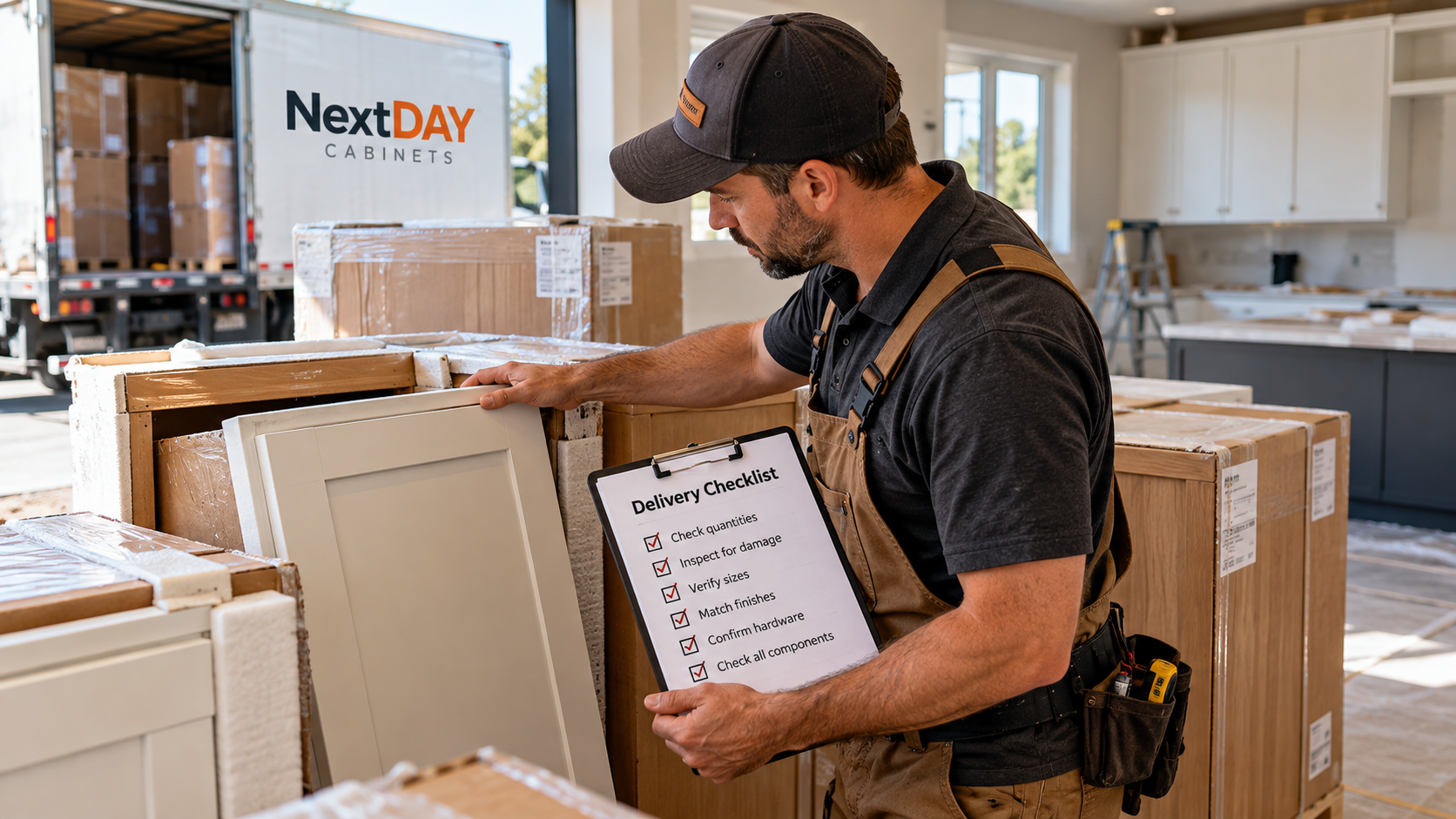

For contractors, builders, and remodelers, receiving kitchen cabinets is an important checkpoint between procurement and installation. A shipment may arrive on schedule, but that does not automatically mean every cabinet, panel, hardware package, and finishing component is present and ready to use.
Missing items, visible damage, incorrect cabinet sizes, or mismatched finishes can interrupt installation and create additional coordination work. When several kitchens are being completed at the same time, even a small discrepancy can affect the project schedule.
A consistent cabinet delivery inspection process helps contractors identify potential problems early, document discrepancies, and organize materials before installation begins.
In this guide, we’ll explain how to inspect kitchen cabinets upon delivery, what to check before signing delivery paperwork, and how to prepare the shipment for a smoother installation.
Why Cabinet Delivery Inspection Matters
Cabinet inspection is not simply about checking whether the boxes have arrived. It is about confirming that the delivered materials correspond to the order and identifying issues before they interfere with installation.
A structured inspection can help contractors:
-
- Identify visibly damaged cabinets and packaging.
- Find missing or incorrect items before installation starts.
- Compare delivered components against the approved cabinet order.
- Document discrepancies for follow-up with the supplier or carrier.
- Organize cabinets according to the installation plan.
- Reduce avoidable interruptions during the project.
The earlier a problem is identified, the easier it is to coordinate the next steps without unnecessarily disrupting other trades.
1. Prepare the Order Documents Before Delivery
The inspection process should begin before the truck arrives. Make sure the person receiving the shipment has access to the documents needed to verify the order.
Depending on the project, these may include:
-
- The purchase order or final order confirmation.
- The approved cabinet layout or design.
- The cabinet schedule and item quantities.
- Product descriptions, sizes, and finish selections.
- A packing list or delivery manifest, if supplied.
- Contact information for the supplier and delivery coordinator.
The cabinet schedule is particularly important. A shipment containing the correct number of boxes may still be incomplete if a required filler, finished end panel, molding, or specialty cabinet is missing.
For projects with multiple kitchens, label the documentation by unit, floor, building, or installation phase. This makes it easier to identify where each component belongs.
If the project is still in the planning stage, reviewing a structured guide to how to remodel your kitchen can help the team coordinate cabinet selections, project requirements, and installation preparation.
2. Check the Shipment Against the Packing List
Once the shipment arrives, compare the delivered items with the available order documentation.
Check the following:
-
- Total package and carton counts.
- Cabinet labels and product descriptions.
- Cabinet sizes and configurations.
- Door and drawer front packages.
- Finished panels, fillers, toe kicks, and moldings.
- Hardware and accessory packages.
- Any separately listed specialty components.
Do not assume that every item has arrived simply because the shipment contains the expected number of cartons. Some components may be packaged separately or listed under different item descriptions.
If the shipment includes several cabinet lines or finishes, keep those items clearly separated during the initial count.
Contractor tip: Use a simple receiving checklist and mark each item as verified, missing, damaged, or requiring further inspection. This creates a clear record of what was checked and what remains unresolved.
3. Inspect Packaging for Visible Damage
Before moving the cabinets into storage or opening the cartons, examine the exterior packaging.
Look for:
-
- Crushed or punctured cartons.
- Torn or open packaging.
- Broken corners or visibly deformed boxes.
- Signs of moisture exposure.
- Damaged protective wrapping.
- Evidence that packages may have shifted during transportation.
Photograph any visible damage before moving or unpacking the affected items, where practical. Include the package label and enough surrounding detail to identify the item.
Follow the carrier’s applicable inspection and reporting procedures. If the delivery paperwork provides a way to record visible damage or exceptions, document the issue accurately rather than signing a statement that incorrectly describes the shipment as undamaged.
Packaging damage does not always mean the cabinet itself is damaged, but it is a reason to inspect the contents carefully.
4. Check Cabinet Boxes, Doors, and Finishes
After the initial receiving check, inspect accessible cabinet components for visible defects.
Depending on the cabinet type and packaging, the inspection may include:
-
- Scratches, chips, dents, or cracked surfaces.
- Damaged cabinet corners or edges.
- Warping or other visible deformation.
- Loose or damaged hinges and drawer hardware.
- Finish inconsistencies that are noticeable under normal lighting.
- Incorrect door styles or finish colors.
- Broken glass or other specialty components, where applicable.
Compare the delivered finish and door style with the approved selection rather than relying on memory or an online photograph alone.
For larger projects, inspect representative items from each product type and finish, then follow the supplier’s instructions and project requirements for any additional inspection. Do not assume that checking one carton proves that every item in the shipment is undamaged.
If the cabinets arrive flat-packed, distinguish between damage to the packaging and damage to the actual components. Where assembly is required, follow the manufacturer’s inspection and assembly instructions.
5. Verify Cabinet Dimensions and Configurations
A cabinet can be undamaged and still be incorrect for the project.
Before installation, compare the relevant dimensions and configurations against the approved cabinet layout.
Confirm:
-
- Width, height, and depth where applicable.
- Base, wall, and tall cabinet types.
- Corner cabinet configurations.
- Drawer and door arrangements.
- Appliance openings and clearances.
- Finished ends and exposed panels.
- Filler sizes and other items needed to complete the cabinet run.
Pay particular attention to items that affect several parts of the installation. A wrong corner cabinet or an incorrect appliance opening may require more coordination than a minor cosmetic issue.
If a discrepancy appears, compare the delivered item with the final approved order rather than immediately assuming that the supplier sent the wrong product. Changes made during design approval can sometimes create differences between an earlier drawing and the final order.
6. Separate Missing Items From Damaged Items
Missing components and damaged components require different follow-up actions. Record them separately so the issue can be communicated clearly.
| Issue | What to record | Recommended next step |
|---|---|---|
| Missing cabinet | Item description, quantity, and order reference | Check the packing list and confirm whether the item was shipped separately |
| Damaged cabinet | Item label, visible damage, and photographs | Follow the supplier’s damage-reporting process |
| Incorrect size | Ordered specification and delivered dimensions | Compare against the approved order and request clarification |
| Incorrect finish | Ordered finish and delivered label or sample | Verify the approved selection and contact the supplier |
| Missing hardware | Cabinet or hardware package reference | Check the package contents and order documentation |
| Unclear discrepancy | Item identification and reason for concern | Hold the affected item for review before installation |
Keep the affected items identifiable and avoid discarding packaging or labels that may be needed for the review.
Contact the appropriate supplier or delivery representative promptly. Provide the order reference, item details, photographs, and a concise description of the discrepancy.
When sourcing cabinets for multiple projects, a consistent process for checking orders and communicating discrepancies is especially important.
Contractors can review the available wholesale kitchen cabinets for contractors to learn more about NextDAY Cabinets’ contractor-focused cabinet offerings and project support.
Do not promise a replacement date or assume that a replacement will be available immediately. Confirm the next steps with the supplier and account for any potential scheduling impact.
7. Organize Cabinets Before Installation
Once the initial inspection is complete, organize the materials so the installation team can locate the right items efficiently.
A practical approach is to:
-
- Group cabinets by kitchen, unit, or project area.
- Keep labels visible and readable.
- Separate verified items from items awaiting inspection or clarification.
- Store doors, panels, moldings, and hardware with their corresponding order references.
- Protect cabinets from moisture, impact, and unsuitable storage conditions.
- Maintain clear access routes for handling and installation.
Follow the manufacturer’s storage requirements, especially for temperature, humidity, stacking, and protection from moisture. Avoid placing cabinets in locations where they may be exposed to leaks, construction debris, or unnecessary handling.
For projects involving multiple units, label each group clearly. This helps prevent materials intended for one kitchen from being installed in another.
8. Coordinate Inspection With the Installation Schedule
Cabinet delivery inspection should be connected to the construction schedule rather than treated as an isolated task.
Before installation begins, confirm that:
-
- The site is ready to receive and store the cabinets.
- The approved cabinet layout is available to the installation team.
- The delivered items have been checked against the order.
- Known discrepancies have been reported.
- Required components are available for the planned installation stage.
- The team understands which items are ready for installation and which require follow-up.
This is especially important when cabinet installation affects countertop templating, appliance fitting, plumbing, electrical work, or other finishing trades.
If an essential component is missing, discuss the scheduling implications before the installation team reaches that part of the project. In some cases, other work can continue; in others, proceeding may create rework or additional labor.
For RTA cabinets, include assembly time and the inspection of assembled cabinet boxes in the installation plan. Follow the product instructions and verify that the units are properly assembled before installation.
9. Use a Standard Cabinet Receiving Checklist
A written checklist makes the process repeatable across projects and helps different team members follow the same procedure.
Kitchen Cabinet Delivery Checklist
Before delivery
-
- Obtain the final order confirmation and cabinet schedule.
- Confirm the receiving location and responsible team member.
- Prepare a space for unloading and temporary storage.
- Keep the approved layout and item list accessible.
During delivery
-
- Check package counts against the available delivery documents.
- Inspect packaging for visible damage.
- Photograph and document visible discrepancies.
- Record any delivery exceptions according to the applicable procedure.
After unloading
-
- Compare cabinet labels and items with the approved order.
- Check accessible cabinet surfaces and components for visible damage.
- Verify relevant sizes, styles, and finishes.
- Check panels, fillers, moldings, and hardware packages.
- Separate items requiring further review.
- Report missing, damaged, or incorrect items.
Before installation
-
- Group materials by kitchen or installation phase.
- Store cabinets according to manufacturer requirements.
- Confirm that essential components are available.
- Communicate unresolved issues to the installation team.
- Update the project schedule if necessary.
The checklist should be adapted to the product line, shipment size, supplier instructions, and contractual receiving requirements.
10. What Contractors Should Do When a Delivery Problem Is Found
Finding a discrepancy does not necessarily mean the entire project must stop. The right response depends on the item, the severity of the issue, and the installation sequence.
Step 1: Document the issue. Record the item, order reference, quantity, condition, and relevant photographs.
Step 2: Verify the approved specification. Compare the item with the final order and current layout.
Step 3: Notify the appropriate contact. Follow the supplier’s and carrier’s reporting requirements.
Step 4: Identify the affected work. Determine whether the issue affects one cabinet, one kitchen, or a larger portion of the project.
Step 5: Agree on the next action. Confirm whether clarification, a replacement component, or another approved resolution is required.
Step 6: Update the schedule and records. Record the issue, responsible person, next step, and resolution status.
Do not install a visibly damaged or incorrectly specified item simply to keep the schedule moving. At the same time, do not delay unrelated work unnecessarily when the project team can safely proceed with other approved tasks.
The objective is to resolve the issue with clear documentation and minimal avoidable disruption.
Final Thoughts
A reliable cabinet delivery inspection process helps contractors identify discrepancies before they become installation problems. Preparing the order documents, checking package counts, inspecting visible condition, verifying specifications, and organizing materials can make the transition from delivery to installation more predictable.
The process does not eliminate every possible issue, but it gives the project team a consistent way to identify problems, document them, and coordinate the next steps.
For contractors, builders, and remodelers managing multiple projects, a standard receiving checklist is a practical addition to the overall cabinet procurement and installation workflow.
Planning a cabinet order for your next project? Explore NextDAY Cabinets’ pickup and delivery information and contact the team to discuss the requirements for your project.
Frequently Asked Questions
Should contractors inspect kitchen cabinets before installation?
Yes. Contractors should check the delivered items against the approved order, inspect accessible components for visible damage, and document discrepancies before installation begins.
What should be checked when kitchen cabinets arrive?
Check package counts, cabinet labels, product types, dimensions, finishes, panels, fillers, moldings, hardware, and visible signs of damage. The final inspection should reflect the project requirements and supplier instructions.
What should I do if cabinets arrive damaged?
Document the damage with photographs, retain relevant labels and packaging where practical, and follow the supplier’s and carrier’s reporting procedures. Confirm the next steps before installing the affected item.
What if a cabinet is missing from the delivery?
Compare the shipment with the packing list and final order. Confirm whether the item was shipped separately, then contact the appropriate supplier representative with the order reference and missing-item details.
Can cabinet installation begin before every item has been inspected?
The decision depends on the project, the inspection requirements, and whether the unchecked items affect the planned work. Resolve critical discrepancies before installing affected components, and coordinate any partial installation with the project team.
How can contractors reduce cabinet delivery problems?
Use accurate order documentation, prepare the receiving area, assign responsibility for inspection, follow a consistent checklist, and report discrepancies promptly. Confirming the order and installation requirements before delivery also helps reduce avoidable surprises.