Kitchen Cabinet Tariffs in 2026: What Contractors and Builders Need to Know About Section 232 Tariff Updates

Kitchen cabinet tariffs in 2026 remain one of the most significant cost factors reshaping the remodeling and construction industry across the United States. Since October 14, 2025, a 25% Section 232 tariff has been in effect on all imported kitchen cabinets, bathroom vanities, and their component parts. While headlines in early January reported that tariffs were “canceled,” the reality is more nuanced: only the planned increase to 50% was delayed until January 1, 2027. The current 25% duty remains fully active and continues to directly impact project budgets, supplier pricing, and lead times for contractors, builders, and dealers nationwide.
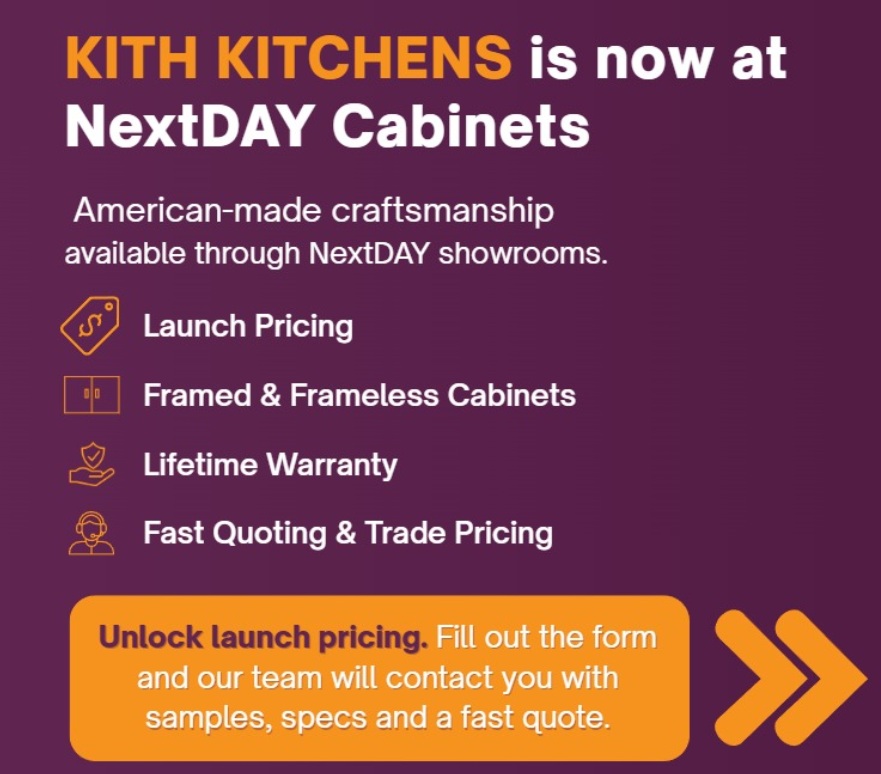
For trade professionals working in markets like Virginia, Maryland, and the greater Mid-Atlantic region, understanding the precise scope of these tariffs is critical to maintaining profit margins and providing accurate quotes to clients. Whether you source imported RTA cabinets or partner with domestic manufacturers like Kith Kitchens through wholesale distributors like NextDAY Cabinets, this guide breaks down everything you need to know about the current kitchen cabinet tariff landscape and how to position your business for stability in 2026 and beyond.
Key Takeaways
- A 25% Section 232 tariff on imported kitchen cabinets and vanities has been in effect since October 14, 2025, and remains active throughout 2026.
- The planned increase to 50% was delayed on December 31, 2025, and is now scheduled for January 1, 2027.
- Chinese-origin cabinets may face combined duty rates exceeding 70% when AD/CVD duties stack with Section 232 tariffs.
- Domestic cabinet manufacturers like Kith Kitchens are largely insulated from tariff-driven price volatility.
- Contractors partnering with wholesale distributors offering American-made cabinets gain a competitive advantage in pricing stability and faster delivery.
- The February 2026 Supreme Court ruling on IEEPA tariffs does not affect Section 232 cabinet tariffs, which operate under separate legal authority.
Understanding Section 232 Kitchen Cabinet Tariffs
The term “kitchen cabinet tariffs” refers specifically to the import duties imposed under Section 232 of the Trade Expansion Act of 1962. Unlike the more commonly discussed reciprocal tariffs or the IEEPA-based country-specific duties, Section 232 tariffs are grounded in national security concerns. The Department of Commerce completed an investigation in early 2025 that determined the volume and conditions of wood product imports—including kitchen cabinets, bathroom vanities, and upholstered furniture—threatened to impair national security by undermining domestic manufacturing capacity.
This distinction matters enormously for contractors and builders because Section 232 tariffs operate under a completely different legal framework than the tariffs that were recently struck down by the Supreme Court. While IEEPA-based reciprocal tariffs were discontinued on February 24, 2026, and replaced with a 15% Section 122 temporary import duty, the Section 232 tariffs on kitchen cabinets remain fully intact and are not affected by these legal developments. This is a critical point that many news reports have failed to clarify, leaving contractors confused about whether cabinet tariffs are still in effect.
The specific HTSUS (Harmonized Tariff Schedule) classifications affected include 9403.40.9060, 9403.60.8093, and 9403.91.0080 for completed kitchen cabinets, vanities, and their parts. These codes cover everything from fully assembled pre-assembled cabinets to RTA cabinet components and hardware kits imported for assembly. If you are sourcing any cabinet products that cross a U.S. border, they are almost certainly subject to these duties.
Section 232 Cabinet Tariff Quick Facts
| Detail | Information |
| Legal Authority | Section 232, Trade Expansion Act of 1962 |
| Effective Date | October 14, 2025 |
| Current Rate | 25% ad valorem on kitchen cabinets & vanities |
| Planned Increase | 50% (delayed from Jan 1, 2026 to Jan 1, 2027) |
| Products Covered | Completed cabinets, vanities, parts, RTA kits |
| HTSUS Codes | 9403.40.9060, 9403.60.8093, 9403.91.0080 |
| Exempt Countries | UK (10%), EU & Japan (15%) under trade agreements |
| Supreme Court Impact? | No – Section 232 remains under separate authority |
Complete Timeline: Kitchen Cabinet Tariffs From Announcement to Delay
Understanding the chronology of kitchen cabinet tariffs in 2026 helps contractors and builders make sense of conflicting media reports and plan their sourcing strategies with confidence.
March 2025: Investigation Launched
The Department of Commerce initiated a Section 232 investigation into timber, lumber, and derivative wood products, including kitchen cabinets. The investigation examined how import volumes from countries like Vietnam, China, Malaysia, and Canada affected domestic manufacturing capacity and supply chain security.
September 29, 2025: Presidential Proclamation Signed
President Trump signed the proclamation establishing Section 232 tariffs on wood products. The order set a 25% tariff on kitchen cabinets and vanities effective October 14, 2025, with an automatic escalation to 50% on January 1, 2026. Separately, softwood lumber received a 10% tariff, and upholstered wooden furniture was set at 25% (increasing to 30%).
October 14, 2025: Tariffs Take Effect
The 25% Section 232 tariff on imported cabinets and vanities went into effect. Notably, there was no “goods-on-the-water” exemption—products already in transit were subject to the new rates upon arrival at U.S. ports. The KCMA and the American Kitchen Cabinet Alliance (AKCA) publicly supported the tariffs as a step toward reviving domestic cabinet manufacturing.
November 2025: Industry Reaction and Price Adjustments
The NKBA reported that more than half of surveyed kitchen and bath professionals expected tariffs to stunt revenue growth and compress profit margins. Cabinet suppliers importing from Vietnam and China began raising prices by 10-15% to offset new duty costs. The Consumer Price Index for kitchen and dining room furniture rose 4.6% year-over-year, significantly outpacing the overall 2.7% CPI increase.
December 31, 2025: 50% Increase Delayed
In a last-minute decision, President Trump signed a new proclamation delaying the tariff increase from 25% to 50% by one full year. The increase is now scheduled for January 1, 2027. The White House cited “productive negotiations with trade partners” as the reason. This is the event that many media outlets reported as tariffs being “canceled”—which is misleading, as the 25% base rate remains fully in effect.
February 2026: Supreme Court and IEEPA Tariff Changes
The Supreme Court ruled against IEEPA-based reciprocal tariffs, leading to their discontinuation on February 24, 2026. A replacement 15% global tariff under Section 122 was immediately implemented. However, products already covered by Section 232 tariffs—including kitchen cabinets—are exempt from the new Section 122 tariff and remain subject only to their existing Section 232 rates.
 Kitchen Cabinet Tariff Rates by Country in 2026
Not all kitchen cabinet tariffs are created equal. The effective duty rate a contractor faces depends heavily on the country of origin. For trade professionals evaluating wholesale cabinet pricing, understanding these country-specific variations is essential for accurate cost estimation.
| Source Country | Section 232 Rate | AD/CVD (if appl.) | Est. Total Duty | USMCA Exempt? |
| China | 25% | Up to 45%+ | 70%+ | N/A |
| Vietnam | 25% | Varies | 46%+ combined | N/A |
| Canada | 25% | Possible | 25-35% | No |
| Malaysia/Thailand | 25% | Varies | 24-37%+ | N/A |
| EU Member States | 15% | None typical | 15% | N/A |
| United Kingdom | 10% | None typical | 10% | N/A |
| Japan | 15% | None typical | 15% | N/A |
| U.S. Domestic | 0% | N/A | 0% | N/A |
Chinese-origin cabinets face the steepest combined rates, often exceeding 70% when existing antidumping and countervailing duties from Section 301 investigations are layered on top of the new Section 232 tariff. Vietnam, which had become the largest single source of imported cabinets to the U.S., now faces a combined rate approaching 46%. Even Canadian products—despite the USMCA trade agreement—are not exempt from Section 232 duties on cabinets. The clear takeaway for contractors: domestically manufactured cabinets carry a 0% tariff burden.
How Kitchen Cabinet Tariffs Impact Contractor and Builder Pricing
For contractors and builders managing project budgets, the practical impact of kitchen cabinet tariffs in 2026 goes far beyond the headline percentage. The tariff affects your business across multiple dimensions.
Direct Cost Increases
A UBS analyst estimated that the 25% cabinet tariff adds approximately $280 to the average single-family home construction cost for cabinets alone. However, for kitchen-specific remodels where cabinets represent 29-35% of the total budget, the impact is far more pronounced. Stock imported cabinets that previously cost $3,000 wholesale may now run $3,750-$4,200 after the tariff pass-through. Semi-custom imported options that were $10,000 could jump to $12,500 or more.
Reduced Product Variety
Supply chain management experts at Michigan State University have noted that tariffs tend to affect product variety more than absolute pricing. Importers are becoming more selective, scaling back orders to focus on bestselling styles with the highest profit margins. For contractors, this means fewer options to present to clients—particularly in the budget and mid-range segments that rely heavily on imported RTA cabinets.
Quote Validity and Price Lock Challenges
One of the biggest operational headaches for trade professionals is the inability to guarantee quotes over standard project timelines. Suppliers importing cabinets may adjust pricing between the time a quote is issued and the time cabinets are ordered, especially if tariff rates change. This price volatility creates uncertainty for both contractors and their clients.
Tariff Impact on Cabinet Pricing: Before vs. After
| Cabinet Type | Pre-Tariff Cost | With 25% Tariff | If 50% (2027) |
| Stock/RTA (Imported) | $2,500 – $4,000 | $3,125 – $5,000 | $3,750 – $6,000 |
| Semi-Custom (Imported) | $8,000 – $15,000 | $10,000 – $18,750 | $12,000 – $22,500 |
| Domestic Wholesale | $3,000 – $8,000 | $3,000 – $8,000 | $3,000 – $8,000 |
| Custom (Domestic) | $15,000 – $30,000+ | $15,000 – $30,000+ | $15,500 – $31,000+ |
As the table illustrates, domestic wholesale cabinets offer the most pricing stability in the current tariff environment. While domestic manufacturers may face marginal increases due to imported hardware, their core pricing remains insulated from Section 232 duties.
Imported vs. Domestic Cabinets: A Complete Kitchen Cabinet Tariff Comparison
The cabinet tariff landscape has fundamentally changed the math behind the “imported vs. domestic” decision. For years, imported cabinets—particularly RTA cabinets from Vietnam and China—offered a substantial price advantage that justified longer lead times and occasional quality inconsistencies. With a 25% tariff now layered on top of already rising freight and material costs, that equation no longer holds for many project types.
| Factor | Imported Cabinets | Domestic Wholesale |
| Base Unit Cost | Lower initial cost | Competitive wholesale pricing |
| Tariff Exposure | 25% Section 232 + AD/CVD | 0% tariff on finished cabinets |
| Lead Time | 6-14 weeks (port delays) | 3-5 days stock (NextDAY) |
| Price Stability | Volatile – tariff changes | Stable – locked pricing |
| Quality Certification | Varies widely | KCMA certified, CARB Phase 2 |
| Warranty Support | Limited; overseas claims | Domestic warranty, local support |
| Product Variety (2026) | Declining as importers cut SKUs | Full range maintained |
When you account for tariff costs, longer lead times, potential port delays, and declining variety, domestic wholesale cabinets often deliver equal or better total value. For contractors running multiple projects, the 3-5 day delivery from distributors like NextDAY Cabinets can mean completing jobs weeks ahead of competitors waiting on imported shipments.
 How to Protect Your Business from Kitchen Cabinet Tariff Volatility
Smart contractors are not waiting for tariff policy to stabilize—they are building resilient sourcing strategies that perform regardless of what happens in 2027. Here are practical steps every trade professional should consider:
1. Establish a Domestic Wholesale Partnership
The single most effective hedge against kitchen cabinet tariffs is to source primarily from domestic manufacturers. Wholesale programs offered by distributors like NextDAY Cabinets give contractors access to wholesale pricing on American-made Kith Kitchens product lines—from budget-friendly KithOne options to premium Eudora frameless designs—without any tariff surcharge.
2. Diversify Your Product Tiers
Rather than relying exclusively on one price tier, build your offering around a range that includes entry-level domestic stock cabinets (like the KithOne line), mid-range semi-custom options, and premium custom solutions. This allows you to absorb tariff-driven shifts in the imported segment without losing projects to sticker shock.
3. Lock In Pricing Early
With the 50% tariff increase potentially arriving on January 1, 2027, early 2026 is an optimal window to lock in pricing with domestic suppliers. Even if the increase is delayed again, locking in current rates protects against any interim adjustments from material cost inflation or component-level tariff impacts.
4. Educate Your Clients
Contractors who proactively explain the tariff situation to homeowners build trust and position themselves as knowledgeable advisors. Many clients have heard alarming headlines about 50% tariffs and assume their entire project budget is affected. Showing them that you source tariff-free domestic cabinets can be a powerful differentiator that closes deals.
5. Monitor Policy Changes
The Department of Commerce is required to produce a report by October 1, 2026, on import levels and domestic industry conditions, which could lead to additional duties on hardwood timber, lumber, or derivative products. Stay connected with industry associations like the NKBA and the NAHB for real-time updates.
The Supreme Court Ruling and What It Means for Kitchen Cabinet Tariffs
In February 2026, the Supreme Court issued a landmark decision invalidating tariffs imposed under the International Emergency Economic Powers Act (IEEPA). This ruling prompted the White House to transition to Section 122 tariffs—a temporary 15% global import duty that took effect February 24, 2026. Many contractors have asked: does this mean cabinet tariffs are gone?
The answer is no. The Section 232 tariffs on kitchen cabinets, vanities, and wood furniture operate under entirely different legal authority (the Trade Expansion Act of 1962) and were not part of the IEEPA-based tariffs the Court struck down. In fact, products already covered by Section 232 tariffs are specifically exempt from the new Section 122 tariff. This means imported kitchen cabinets still face the same 25% Section 232 duty they have since October 2025—no more, but also no less.
Tariff Authority Comparison: How Different Tariffs Apply to Cabinets
| Tariff Type | Status (Feb 2026) | Applies to Cabinets? | Rate |
| Section 232 | Active | Yes – Primary tariff | 25% |
| IEEPA Reciprocal | Ended Feb 24 | No longer applicable | N/A |
| Section 122 (New) | Active since Feb 24 | No – Exempt | 15% (other goods) |
| Section 301 (China) | Active | Yes – Stacks on 232 | 7.5-25% |
| AD/CVD | Active | Yes – Country specific | Varies |
Why Wholesale Cabinet Partnerships Matter More Than Ever in 2026
The current kitchen cabinet tariff environment has elevated the importance of having a reliable wholesale partner. For contractors, builders, and dealers in the Mid-Atlantic region and beyond, a strong wholesale relationship provides benefits beyond simple cost savings.
Pricing Predictability
Domestic wholesale partners can offer stable pricing that is not subject to tariff fluctuations. NextDAY Cabinets provides wholesale pricing on Kith Kitchens product lines that reflects domestic manufacturing costs—not the volatile calculus of import duties, freight surcharges, and currency exchange rates.
Speed to Project Completion
With imported cabinet lead times stretching to 6-14 weeks (and sometimes longer due to port congestion and customs delays), domestic options with 3-5 day delivery for stock items represent a massive competitive advantage. NextDAY Cabinets operates showrooms in Alexandria, Chantilly, Richmond, Beltsville, Woodbridge, and Chicago, supporting contractors across the East Coast and Midwest.
Full Product Range Without Tariff Gaps
While importers are cutting SKUs and limiting variety to maintain margins, domestic manufacturers maintain their full catalogs. Through NextDAY Cabinets, contractors access everything from the affordable KithOne line to the premium Eudora frameless collection—all domestically produced and KCMA certified for quality assurance.
Dealer Programs Built for Trade Professionals
NextDAY Cabinets’ dealer program is specifically structured for contractors, builders, and dealers who need volume pricing, dedicated account support, and reliable supply. In an era where tariff uncertainty is pushing many importers to renegotiate terms mid-project, having a domestic wholesale partner with locked-in pricing is invaluable.
What to Watch: Kitchen Cabinet Tariffs Beyond 2026
While the immediate picture is clear—25% tariffs on imported cabinets through at least December 31, 2026—several developments could reshape the landscape:
- October 2026 Commerce Report: The Secretary of Commerce will assess import levels and domestic industry health. This report could recommend expanding tariffs to additional wood products.
- January 1, 2027 Deadline: The delayed 50% tariff increase is currently scheduled to take effect. Whether it proceeds depends on trade negotiations and political dynamics.
- New Section 301 Investigations: President Trump has initiated new investigations into unfair trade practices that could lead to additional country-specific tariffs.
- Domestic Manufacturing Expansion: The AKCA reports that tariff protection is enabling domestic manufacturers to invest in capacity expansion, which could increase supply over time.
Partner with NextDAY Cabinets: Tariff-Stable Wholesale Pricing for Trade Professionals
In an industry disrupted by kitchen cabinet tariffs and regulatory uncertainty, NextDAY Cabinets offers contractors, builders, and dealers the stability and reliability they need. As a wholesale distributor of American-made Kith Kitchens products, NextDAY Cabinets provides tariff-free cabinet sourcing, competitive wholesale pricing, 3-5 day delivery on stock items, KCMA-certified quality, and dedicated trade professional support across six showroom locations.
Ready to insulate your business from tariff volatility? Contact NextDAY Cabinets today or visit one of our showrooms in Alexandria, Chantilly, Woodbridge, Richmond, Beltsville, or Chicago to explore our full range of wholesale cabinet solutions.
FAQ: Kitchen Cabinet Tariffs 2026
1. Are kitchen cabinet tariffs still in effect in 2026?
Yes. The 25% Section 232 tariff on imported kitchen cabinets and vanities has been in effect since October 14, 2025, and remains active throughout 2026. Only the planned increase to 50% was delayed.
2. Did the Supreme Court ruling eliminate cabinet tariffs?
No. The February 2026 Supreme Court ruling only affected IEEPA-based tariffs. Section 232 tariffs on kitchen cabinets operate under separate legal authority and are completely unaffected.
3. When will the 50% tariff on kitchen cabinets take effect?
The increase from 25% to 50% has been delayed until January 1, 2027. It could be delayed again, modified, or implemented depending on ongoing trade negotiations.
4. Are U.S.-made kitchen cabinets affected by tariffs?
Domestically manufactured cabinets are not subject to import tariffs. Some domestic manufacturers may experience minor cost increases from imported hardware or specialty components, but core cabinet pricing remains stable.
5. How much do tariffs add to kitchen remodel costs?
For projects using imported cabinets, the 25% tariff typically translates to a 15-25% retail price increase. A $3,000 imported cabinet order could cost $3,750-$4,200 with the tariff factored in.
6. Which countries are exempt from the 25% cabinet tariff?
The UK faces a reduced 10% rate, while EU member states and Japan face 15% under existing trade agreements. All other countries face the full 25% Section 232 rate.
7. How can contractors protect profit margins from tariff increases?
Partner with domestic wholesale distributors like NextDAY Cabinets that offer tariff-free American-made options. Diversify product tiers, lock in pricing early, and educate clients about sourcing alternatives.
8. Do tariffs apply to RTA (ready-to-assemble) cabinet kits?
Yes. The Section 232 tariff applies to completed kitchen cabinets, vanities, and parts imported for use in kitchen cabinets and vanities—including RTA kits, component parts, and hardware kits.
External Links Used:
Internal Links (6 total):