
Kitchen Cabinet Materials: What Contractors Should Know Before Choosing Cabinets

Choosing the right kitchen cabinet material is an important decision for contractors, builders, and remodeling professionals.
The material affects more than the appearance of a kitchen. It can also influence durability, maintenance considerations, project cost, finish options, installation requirements, and the overall suitability of the cabinets for a particular project.
With options including solid wood, plywood, MDF, particleboard, laminate, and other engineered materials, contractors need to look beyond the material name when evaluating cabinet options.
The right choice depends on the project, the client’s expectations, the kitchen environment, the desired appearance, the budget, and the complete cabinet construction.
This guide explains the most common kitchen cabinet materials and the factors contractors should consider before specifying or ordering cabinets.
Why Cabinet Material Matters for Contractors
For homeowners, cabinet material may initially appear to be primarily a design decision. For contractors, it is part of a much larger project decision.
Cabinet material needs to work together with the cabinet construction, finish, hardware, budget, installation requirements, delivery schedule, and expected use of the kitchen.
Before selecting a cabinet material, contractors should consider:
- Project type and intended use
- Client expectations
- Cabinet construction
- Durability requirements
- Moisture and environmental conditions
- Desired finish
- Project budget
- Availability and lead time
- Installation requirements
- Supplier support and warranty terms
The objective is not simply to choose the most expensive material. The objective is to select a cabinet system that fits the requirements of the project.
Common Kitchen Cabinet Materials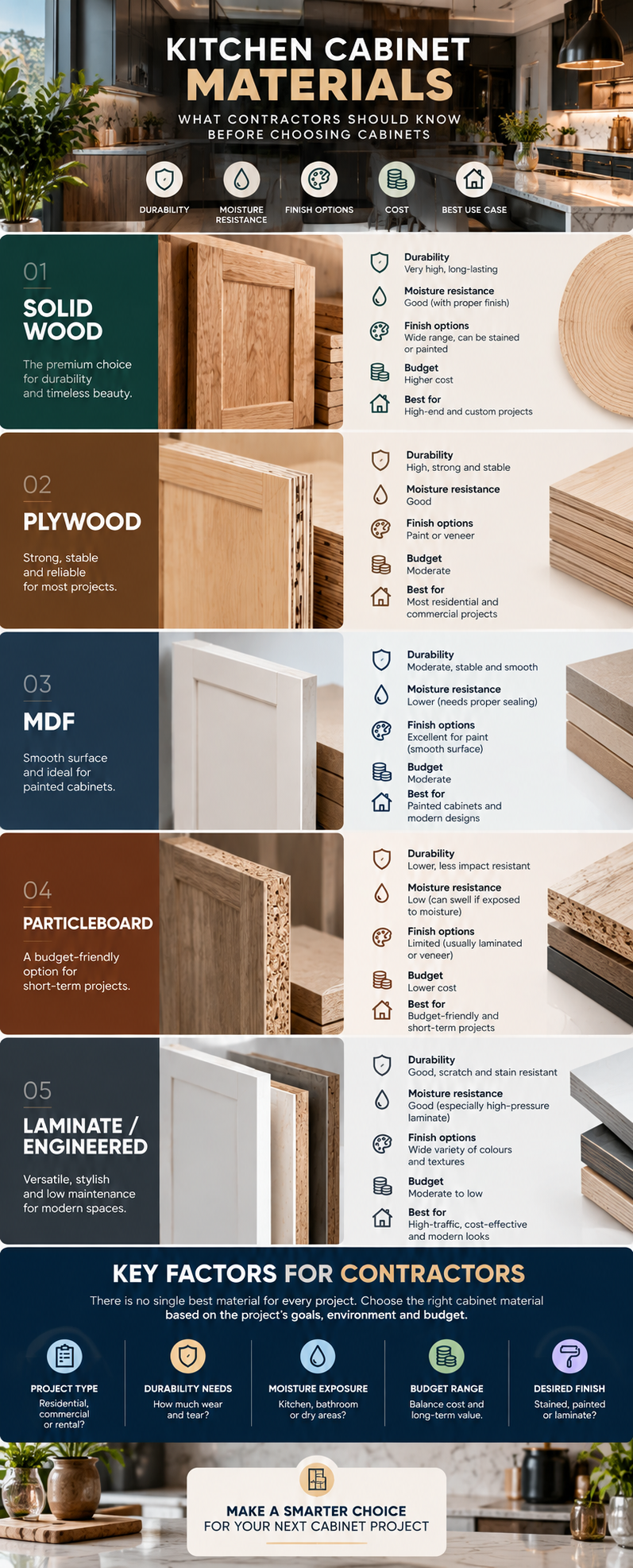
The comparison above provides a quick overview. The right material ultimately depends on the project type, expected durability, moisture exposure, budget, and desired finish.
Kitchen cabinets can be manufactured using several types of solid wood and engineered materials. Each option has different characteristics and may be appropriate for different applications.
Solid Wood
Solid wood is a traditional cabinet material valued for its natural appearance and the character of different wood species. Common hardwood species used in cabinetry include oak, maple, and cherry.
For contractors, solid wood may be worth considering when the project places a strong emphasis on natural appearance, traditional craftsmanship, or a particular wood finish.
However, material selection should still take into account the overall project budget, construction method, finish, and intended use. The important question is not simply whether solid wood is better. It is whether solid wood is appropriate for the project being specified.
Plywood
Plywood is an engineered wood product made from layers of wood veneer bonded together. It is commonly considered in cabinet construction because of its structural characteristics and versatility.
When evaluating plywood cabinets, contractors should look beyond the word “plywood” and review the complete specification.
Important questions include:
- Where is plywood used?
- What thickness is specified?
- How is the cabinet constructed?
- What finish is applied?
- What type of doors and drawer boxes are included?
- What warranty applies?
This distinction matters because the overall cabinet system is more important than one material specification in isolation.
MDF
Medium-density fiberboard, commonly known as MDF, is an engineered wood material made from wood fibers. Its smooth and consistent surface makes it particularly relevant for some painted cabinet applications.
When considering MDF cabinetry, contractors should evaluate the intended application, finish, construction, and environmental conditions rather than treating MDF as a universal solution. Material selection should always be based on the complete product specification.
Particleboard
Particleboard is another engineered wood material commonly used in cabinetry. Its cost characteristics can make it relevant for budget-conscious projects, but contractors should evaluate the complete construction and intended application.
Particular attention should be paid to:
- Cabinet construction
- Edge treatment
- Finish
- Moisture exposure
- Hardware
- Warranty
- Expected use
A material should not be judged independently of the cabinet system in which it is used.
Laminate and Other Engineered Materials
Laminate and other engineered materials provide additional options for cabinet projects where appearance, maintenance, application, and budget all need to be considered.
As with other cabinet materials, the best choice depends on the project. Contractors should evaluate how the surface material works with the cabinet core, construction method, finish, hardware, and intended environment.
How to Choose the Right Cabinet Material for Your Project
Choosing cabinet material becomes easier when contractors evaluate the project systematically.
1 – Consider the Project Type
Not every kitchen project has the same requirements. A high-end residential remodel may prioritize appearance and customization, while a rental property or budget-conscious renovation may place greater emphasis on cost, availability, and practical durability.
At this stage, these are the key questions we need to ask:
- What type of property is this?
- How heavily will the kitchen be used?
- What is the client’s budget?
- Is appearance a primary priority?
- Is customization required?
- How important is delivery speed?
- Are there environmental or moisture considerations?
These questions help narrow the material options before the cabinet is ordered.
2 – Evaluate Durability Requirements
Resilience requirements are another crucial consideration at this stage. Durability should be evaluated in relation to how the kitchen will actually be used.
A kitchen used every day by a large family may have different requirements from a lightly used guest kitchen.
Contractors should consider:
- Frequency of use
- Drawer and door usage
- Weight stored inside cabinets
- Expected service life
- Maintenance requirements
- Exposure to moisture and heat
The goal is to match the cabinet specification to the demands of the project.
3 – Consider Moisture and Environment
Moisture is an important consideration in kitchen cabinet selection. Areas around sinks, dishwashers, and other water sources deserve particular attention.
However, moisture performance should not be evaluated based on the cabinet material alone.
Contractors should consider the complete system, including:
- Cabinet construction
- Material
- Finish
- Edge treatment
- Installation
- Location within the kitchen
This is one reason why simply asking “Which cabinet material is best?” does not always produce a useful answer. Asking the right questions is the key to reaching the right outcome.
The better question is: Which cabinet construction is appropriate for this particular environment?
4 – Consider the Project Budget
Material selection must fit the overall project budget. However, the lowest initial price is not automatically the best value.
Contractors should evaluate: Material + Construction + Finish + Hardware + Warranty + Delivery + Installation
This provides a more realistic comparison between cabinet options. A cost-conscious project may justify a different material choice from a premium remodel.
The objective should be to achieve the appropriate balance between project requirements and total cost.
5 – Consider the Desired Finish
Because focusing on results is always the right approach. Material selection and finish should be considered together.
A painted cabinet project may have different material requirements from a project where the natural appearance and grain of the wood are central to the design.
At this stage, you must consider the following criteria;
- Paint or stain
- Natural wood appearance
- Door style
- Surface consistency
- Edge details
- Overall kitchen design
The material should support the desired final appearance rather than being selected independently.
Cabinet Material vs. Cabinet Construction
One of the most important distinctions contractors should understand is the difference between cabinet material and cabinet construction.
Two cabinets may use different materials and still have very different construction characteristics. When comparing cabinets, look beyond the material name.
When making this comparison, be sure to consider the following criteria;
- Cabinet box construction
- Door construction
- Drawer box construction
- Hardware
- Joinery
- Finish
- Back panel construction
- Shelving
- Warranty
- Installation requirements
This broader approach is consistent with NextDAY’s existing contractor buying guide, which evaluates materials together with construction, hardware, warranty, supplier considerations, measurements, and installation. For more detailed information, see our Kitchen Cabinet Buying Guide for Contractors.
For contractors, the question should therefore not simply be: What is the cabinet made from? It should be: How is the complete cabinet built, and is that construction appropriate for this project? Asking the right questions leads to the right answers and successful implementation.
A Practical Kitchen Cabinet Material Comparison
| Material | General Characteristic | Key Considerations |
| Solid Wood | Natural appearance | Cost, finish, project requirements |
| Plywood | Layered engineered wood | Specification, thickness, construction |
| MDF | Smooth engineered surface | Application, finish, environmental conditions |
| Particleboard | Cost-conscious engineered material | Construction, finish, moisture exposure |
| Laminate | Surface material option | Application, finish, durability requirements |
Important: This table is a decision framework, not a universal ranking. Actual cabinet performance depends on the specific product, construction method, finish, installation, and manufacturer specifications.
Questions Contractors Should Ask Before Ordering Cabinets
Before placing an order, contractors should have clear answers to several questions. We emphasize this point for a reason: asking the right questions for the task at hand will lead to answers that are aligned with the desired outcome. This, in turn, makes it possible to achieve successful results.
What material is used for the cabinet box?
Do not assume that every cabinet component uses the same material.
What material is used for the doors and drawer fronts?
Door and drawer construction may differ from the cabinet box and can affect both appearance and functionality.
What type of finish is applied?
The finish can influence appearance, maintenance requirements, and suitability for the intended application.
What hardware is included?
Review hinges, drawer slides, and other hardware as part of the complete cabinet specification.
What are the warranty terms?
Understand what is covered, the duration of coverage, exclusions, and the process for warranty claims.
What is the expected lead time?
Cabinet selection needs to fit the project’s schedule.
Are replacement components available?
For contractors managing multiple projects, replacement availability can be an important supplier consideration.
Does the supplier provide design or technical support?
Supplier support can help contractors manage ordering, specifications, and project requirements more efficiently.
Cabinet Material Is Only One Part of the Buying Decision
Material selection should not be separated from the rest of the cabinet purchasing process. We emphasize this point for a reason: asking the right questions for the task at hand will lead to answers that are aligned with the desired outcome. This, in turn, makes it possible to achieve successful results.
At this stage, contractors must pay close attention to the following details;
- Accurate kitchen measurements
- Cabinet layout
- Door and drawer configuration
- Finish
- Hardware
- Delivery requirements
- Installation
- Warranty
- Supplier support
Before ordering, contractors should measure the kitchen carefully and document conditions that can affect cabinet layout and installation. For a step-by-step process, see How to Measure Your Kitchen: The Step-by-Step Guide.
This helps connect material selection with the practical stages of the project.
How to Evaluate Cabinet Materials Step by Step
A simple evaluation process can help contractors make more consistent decisions.
Step 1: Define the project requirements
Identify the budget, expected use, design expectations, schedule, and environmental conditions.
Step 2: Shortlist suitable materials
Eliminate materials or constructions that clearly do not fit the project requirements.
Step 3: Compare the complete cabinet specification
Review the cabinet box, doors, drawers, finish, hardware, and construction.
Step 4: Evaluate the supplier
Consider availability, lead time, warranty, delivery, design support, and replacement policies.
Step 5: Confirm the final specification
Before ordering, make sure the selected cabinets meet both the client’s expectations and the project’s practical requirements. For a broader contractor-oriented purchasing framework, see Kitchen Cabinets Buying Guide for Contractors.
What Contractors Should Compare When Evaluating Suppliers
The cabinet material is only one part of supplier evaluation.
Contractors should also compare:
- Product availability
- Lead times
- Pricing structure
- Warranty
- Replacement policies
- Delivery options
- Design support
- Product documentation
- Trade or dealer programs
For contractors sourcing cabinets in volume, these factors can affect the overall economics and scheduling of a project.
NextDAY’s current site positions the company as a wholesale distributor serving contractors, builders, and dealers, with product catalogs and multiple cabinet lines available through its resources.
For broader supplier considerations, contractors can also review Wholesale Cabinets for Contractors: 2026 Sourcing & Pricing Guide.
Final Checklist: Choosing Kitchen Cabinet Materials
Before ordering, contractors can use this checklist:
- Project requirements are clearly defined
- Client budget has been confirmed
- Cabinet material has been evaluated
- Cabinet construction has been reviewed
- Door and drawer construction has been checked
- Finish requirements have been confirmed
- Moisture exposure has been considered
- Hardware specifications have been reviewed
- Warranty terms have been checked
- Lead time has been confirmed
- Delivery requirements have been reviewed
- Kitchen measurements have been verified
- Supplier support requirements have been discussed
A strong cabinet specification should satisfy the requirements of the project not simply look good on a product sheet.
Conclusion
Choosing kitchen cabinet materials should be approached as a project decision rather than simply a material decision.
Solid wood, plywood, MDF, particleboard, laminate, and other materials can all have a place depending on the application. The important question is how each option fits the project’s requirements for durability, appearance, budget, environment, construction, and schedule.
For contractors and builders, the most reliable approach is to evaluate the complete cabinet system rather than focusing on a single material specification.
That means considering the material together with construction, finish, hardware, warranty, availability, delivery, and supplier support.
When these factors are evaluated together, contractors can make more informed cabinet decisions and choose options that are appropriate for both the client and the project.
Ready to evaluate cabinet options for your next project? Talk to NextDAY Cabinets about your project requirements
Frequently Asked Questions
What is the best material for kitchen cabinets?
There is no single cabinet material that is best for every project. The appropriate choice depends on the project’s budget, expected use, design requirements, environment, construction, finish, and supplier specifications.
Are solid wood cabinets better than engineered materials?
Not necessarily. Solid wood and engineered materials have different characteristics and may be appropriate for different applications. Contractors should evaluate the complete cabinet construction rather than selecting a material based on its name alone.
What materials are commonly used to make kitchen cabinets?
Common cabinet materials include solid wood, plywood, MDF, particleboard, laminate, and other engineered materials. The exact combination can vary by manufacturer and product line.
Which cabinet material is best for contractors?
The answer depends on the project. Contractors should consider durability, budget, finish, construction, availability, installation requirements, warranty, and supplier support before selecting a cabinet material.
Does cabinet material affect cabinet cost?
Yes. Material can influence cabinet pricing, but total project cost also depends on construction, design, finish, hardware, quantity, delivery, and installation requirements.
What should contractors look at besides cabinet material?
Contractors should also evaluate cabinet construction, door and drawer specifications, hardware, finish, warranty, availability, lead time, delivery, and supplier support.