NextDAY Closets: Wholesale Closet Systems Built for Contractor Margins and Multi-Unit Speed

Closets get treated like an afterthought on most jobs. Wrong move. On a multi-unit renovation or a builder package, closet systems eat up almost as many line items as the kitchen — rods, shelves, partitions, drawer banks, finish coordination — and a bad supplier relationship there can stall a punch list just as fast as a missing cabinet panel.
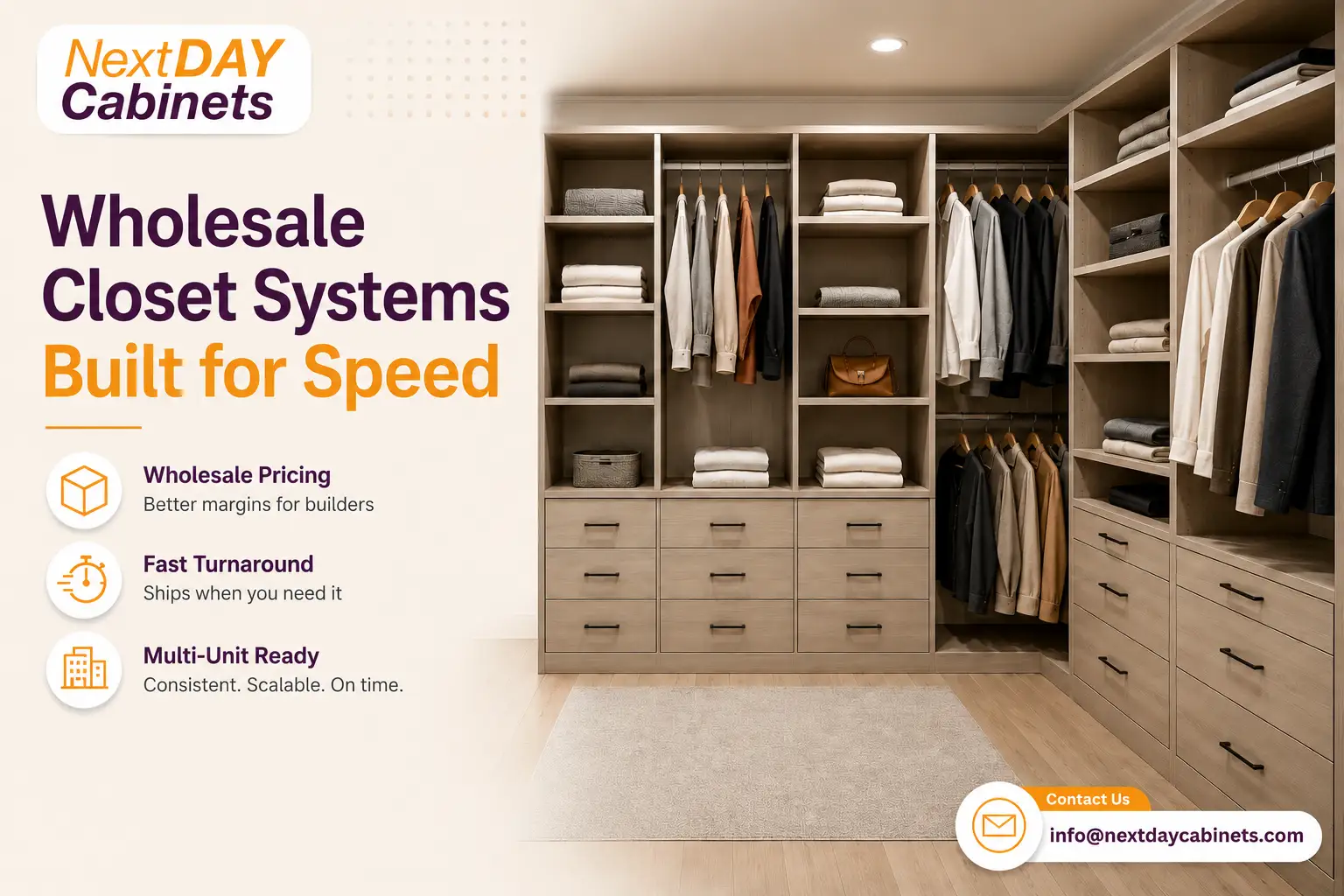
NextDAY Closets gives contractors, builders, property managers, and dealers a wholesale path to closet systems that ship in days instead of months. Built through NextDAY Cabinets‘ partnership with Millcraft, the NextDAY Closet line covers two core configurations — standard wall-hung and upgraded floor-standing — across dozens of pre-built layouts, with the same trade-focused pricing and delivery model that runs through NextDAY’s kitchen and bath divisions.
This guide breaks down what’s actually in the NextDAY Closets system, how the two mounting types compare on real job sites, what to check before you spec a unit, and how the pricing and lead times stack up against custom or imported alternatives.
Key Takeaways
- NextDAY Closets are available in two base systems: standard wall-hanging and upgraded floor-standing, the latter adding usable storage capacity at the base.
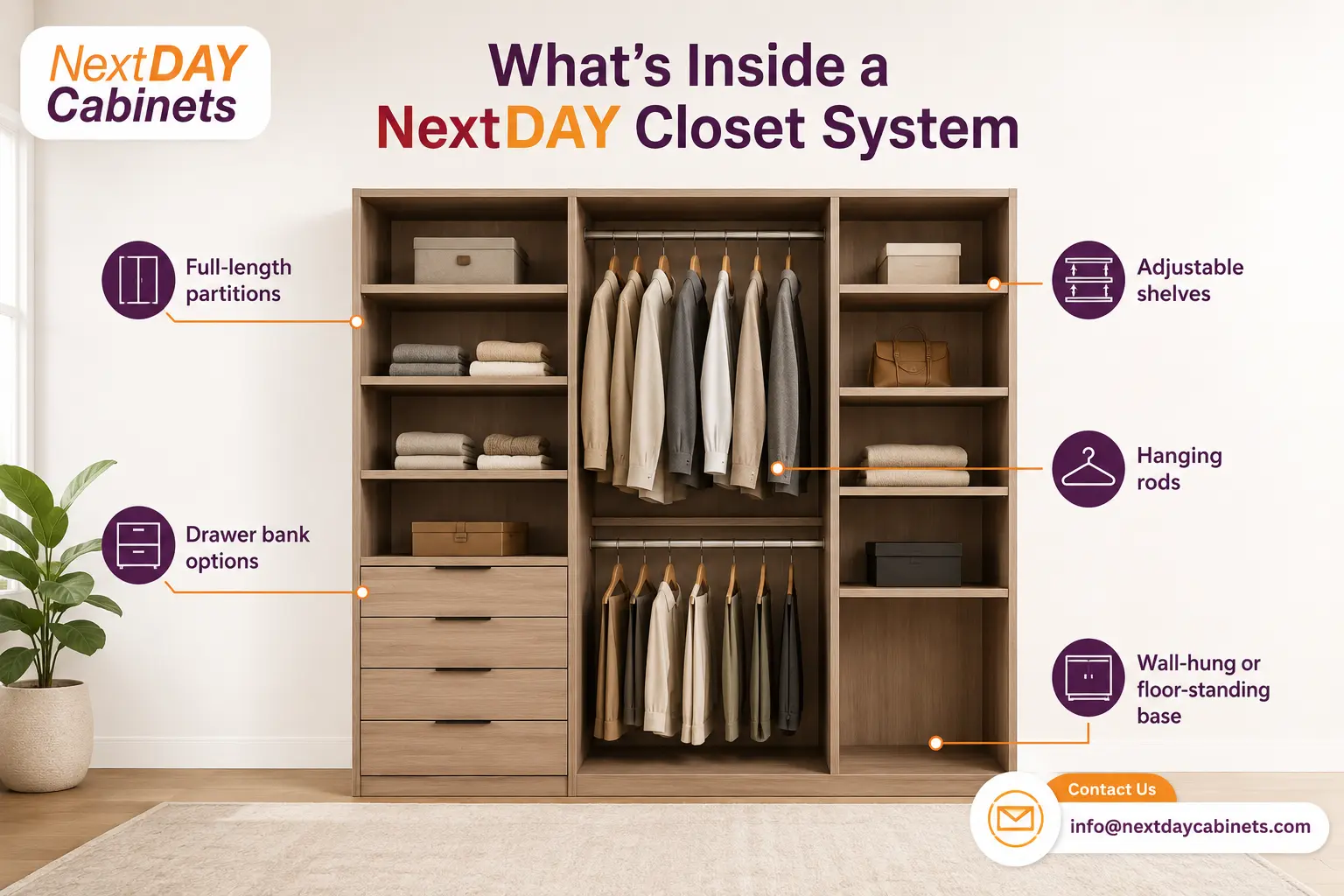
- Full-length solid partitions run the height of each unit — no stacked or segmented panels — which matters for long-term rigidity on heavy-use installs.
- The modular layout lets dealers reconfigure shelving and rod placement without re-ordering panels, useful for rental turns and seasonal swaps.
- Stock configurations carry the same 3-5 day lead time NextDAY runs across its cabinet and vanity lines, with pickup or delivery from six East Coast and Midwest locations.
- Volume pricing and a dealer program apply to closets the same way they apply to cabinetry, and free professional design support is available for layout planning.
- Color, door style, and hardware finish options are confirmed per order through a sales rep rather than locked into a single SKU sheet.
What Is the NextDAY Closets System?
NextDAY Closets is the closet storage line distributed through NextDAY Cabinets, built on Millcraft’s manufacturing platform. It’s positioned the same way the rest of NextDAY’s catalog is positioned — not as a retail product line, but as a wholesale resource for contractors, builders, dealers, and designers who need closet systems that match the speed of everything else on the job.
Two base systems anchor the line. The standard configuration is a wall-hanging system, mounted to the wall above floor level. The upgraded option is a floor-standing system, which adds a base that sits on the floor and opens up additional storage that a wall-hung unit simply can’t offer. Both systems share the same partition and shelving architecture; the difference is mounting method and the storage volume that comes with it.
That distinction sounds minor until you’re standing in a 200-unit rehab deciding which system to standardize on. It isn’t.
Wall-Hung vs. Floor-Standing: Which One Fits the Job?
Every closet job comes down to a handful of variables: wall condition, floor condition, budget per unit, and how much storage the end user actually needs. Here’s how the two NextDAY Closets configurations stack up against each other in the field.
 Wall-Hung vs. Floor-Standing Comparison
For multifamily and property management work, wall-hung is usually the default — it’s cheaper per unit, faster to install across repeated layouts, and floor clearance makes cleaning between tenants simpler. For builder spec homes and remodels where the closet itself is a selling point, floor-standing earns its upgrade cost through the extra storage buyers actually notice.
Construction and Material Specs That Actually Matter
Door style gets all the attention in a showroom. It shouldn’t. What actually determines whether a closet system survives five years of tenant turnover or a decade in a family home is the panel construction underneath the finish.
NextDAY Closet units use full-length solid partitions — meaning each side panel runs the full height of the unit as a single piece, not stacked or spliced sections joined mid-height. That single detail does more for long-term rigidity than almost anything else in the build. Stacked panels flex at the seam over time, especially under load from hanging rods and full shelves. A full-length partition doesn’t have a seam to flex at.
Like most professional-grade closet systems on the market, the panel substrate is thermally fused melamine over an engineered wood core — a material chosen across the industry specifically because it resists scratches, moisture, and fading better than painted MDF, without the cost or lead time of solid wood millwork.
For a multifamily owner running unit turns every twelve to eighteen months, that durability difference shows up directly in the maintenance budget.
 Construction Details and Trade Impact
If you’re speccing closets for a project where finish quality is part of the sales pitch — a higher-end spec home, a condo conversion — ask your rep directly about door profile and hardware upgrades. The base system is built to spec, but the finish layer is where projects differentiate.
Configuration Range: From Reach-Ins to Walk-Ins
NextDAY Closets ship in a wide library of pre-engineered layouts rather than a single fixed size. Wall-hung sets and floor-based sets both come in widths that scale from compact 30-inch reach-in configurations up through 94-inch runs suited to walk-in closets, with combinations of hanging sections, shelf banks, and drawer units mixed within a single layout.
That range matters most on repeatable work. A builder running the same floor plan across forty units doesn’t want to custom-design a closet for every variant — they want a catalog of proven layouts they can drop into a spec sheet and order the same way every time. NextDAY’s configuration library is built for exactly that kind of repeat-and-standardize workflow, and the modular shelf and rod placement means a layout can flex slightly between unit types without a full re-spec.
Why Contractors and Property Managers Spec NextDAY Closets
Three groups drive most of the volume on this product line, and each cares about a different piece of the value proposition.
Contractors and remodelers care about schedule risk. A closet delay at the back end of a renovation is just as disruptive as a missing cabinet panel — it holds up final walkthrough and final payment. NextDAY’s 3-5 day lead time on stock configurations removes closets from the critical path on most projects.
Builders and property managers care about repeatability and margin. Standardizing on one closet system across multiple units means one ordering process, one finish package, and predictable per-unit cost — which is exactly what volume pricing through a dealer account is built to protect.
Designers and dealers care about being able to present something concrete. A 3D layout from NextDAY’s free professional design service gives a client something to react to before money moves, which shortens the sales cycle on the rest of the project.
Buyer Priorities and NextDAY Closet Benefits
Lead Times, Delivery, and Showroom Pickup
Stock NextDAY Closets configurations run the same 3-5 business day lead time that NextDAY applies across its cabinet and vanity catalog — a sharp contrast to custom millwork or imported closet systems, which routinely run four to eight weeks or longer once freight and customs are factored in.
Pickup and delivery run through six locations: Alexandria, Chantilly, Woodbridge, Beltsville, Richmond, and Chicago. That footprint covers Virginia, Maryland, and Illinois, giving contractors in the Mid-Atlantic and Chicagoland markets a regional pickup option instead of waiting on a single national distribution point.
NextDAY Closets vs. Custom or Imported Systems
For phased projects — think a 60-unit rehab rolling out in three phases — that lead time difference is the gap between holding a schedule and explaining a delay to a property owner.
Colors, Doors, and Finish Coordination
NextDAY doesn’t lock the closet line into one fixed finish sheet. Door styles and colors are selected and confirmed directly with a sales rep at order time, which gives contractors room to match closet finish to whatever cabinet or vanity package is already running on the job — useful when a builder wants visual consistency between the kitchen, the bath, and the bedroom closets without ordering from three separate finish systems.
If finish-matching across product categories matters to your project — and on most builder packages, it does — raise it with your rep before placing the order, not after the units arrive.
Common Mistakes When Specifying Closet Systems
A few errors show up over and over on closet orders, and almost all of them are avoidable with a five-minute conversation before the order goes in.
- Speccing floor-standing units without checking subfloor condition. A floor-based system needs to sit level. Uneven or unfinished subfloor turns a same-day install into a half-day shimming job.
- Going wall-hung without confirming blocking. Older construction and some multifamily framing don’t have stud spacing where a wall-hung bracket expects it. Confirm before the unit shows up on site.
- Choosing fixed-shelf layouts to save a few dollars per unit. On rental property especially, the adjustable, modular layout pays for itself the first time a tenant needs a different rod height and you don’t have to send a tech back out.
- Ordering finish by memory across phased builds. Color and door selections confirmed verbally on phase one don’t always carry forward cleanly to phase three. Get it in writing on the PO.
- Treating closets as an afterthought on the schedule. Closets ship fast through NextDAY, but they still need to be ordered early enough to land when the space is actually ready for them — not after drywall is already closed up around an unconfirmed layout.
What to Prepare Before You Order
Closet orders move faster when the prep work happens before the call to your rep, not during it.
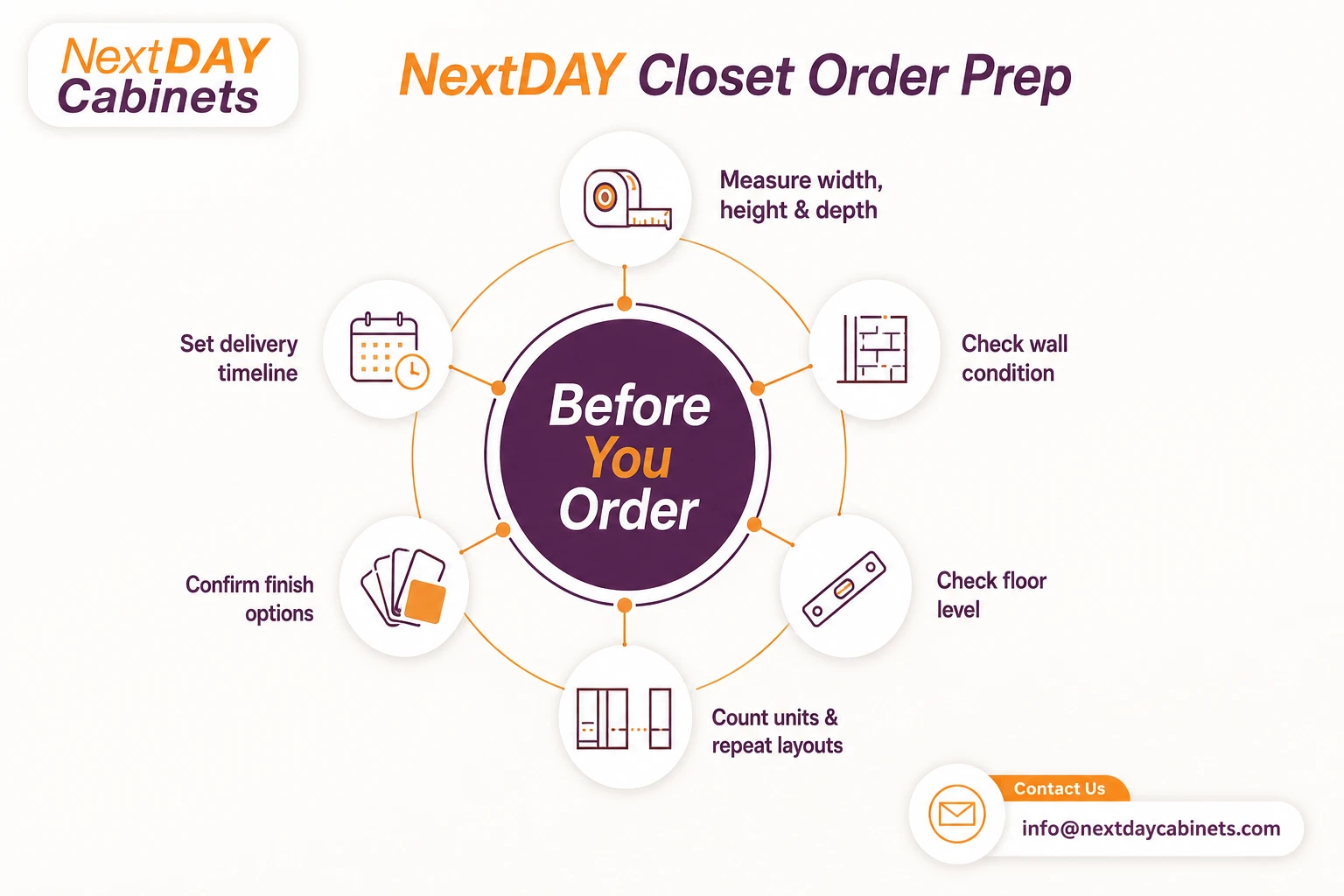
- Opening width, height, and depth for each closet — wall-hung and floor-standing have different clearance needs.
- Wall type and condition: drywall over standard stud spacing, masonry, or anything unusual that affects mounting.
- Floor condition for any floor-standing units, including subfloor flatness.
- Unit count and layout repetition across the project, especially for multi-unit or builder work.
- Preferred door style, color, and hardware finish — or confirmation that you’ll finalize this with your sales rep.
- Project timeline and the date closets actually need to land on site, not just the date the order needs to go in.
Partner With NextDAY Cabinets for Closet Projects
NextDAY Cabinets built its closet line the same way it built its cabinet and vanity catalog — around the needs of contractors, builders, dealers, and property managers, not retail one-off buyers. The Millcraft partnership behind NextDAY Closets brings full-length solid partition construction, a wide configuration library, and finish flexibility, while NextDAY’s distribution model brings the 3-5 day stock lead time, dealer pricing, and free professional 3D design support that trade buyers already expect from the rest of the catalog.
Pickup and delivery run through showrooms in Alexandria, Chantilly, Woodbridge, Beltsville, Richmond, and Chicago. Dealer accounts get volume pricing on closets the same way they do on kitchen and bath products, and the professional design team can turn a rough closet layout into a presentable plan before you ever quote the client.
FAQ: NextDAY Closets
What is the NextDAY Closets system built on?
NextDAY Closets is manufactured through a partnership with Millcraft and distributed wholesale through NextDAY Cabinets, available in standard wall-hanging and upgraded floor-standing configurations.
What’s the difference between wall-hung and floor-standing closet systems?
Wall-hung units mount to the wall above floor level and require solid blocking. Floor-standing units sit on a base on the floor, which adds storage capacity but requires a level subfloor for installation.
How fast can contractors get NextDAY Closets?
Stock configurations ship on the same 3-5 business day lead time NextDAY runs across its cabinet and vanity lines, well ahead of custom or imported closet systems running four to eight weeks or longer.
Can dealers get volume pricing on closet systems?
Yes. Closets are priced through the same wholesale and dealer account structure as NextDAY’s other product categories, with volume discounts available for registered dealers.
Do NextDAY Closets come with design support?
Yes. Free professional 3D design services are available to help contractors and designers turn rough measurements into a finished layout before ordering.
What colors and door styles are available for NextDAY Closets?
Door style and finish options are confirmed directly with a sales rep at order time, allowing builders to coordinate closet finish with existing cabinet or vanity packages on the same job.
Where can contractors pick up or receive delivery of NextDAY Closets?
NextDAY Cabinets operates six locations for pickup and delivery: Alexandria, Chantilly, Woodbridge, Beltsville, Richmond, and Chicago, covering Virginia, Maryland, and Illinois.
Final Thoughts
Closets don’t carry the glamour of a kitchen package, but they sit on the critical path of almost every renovation and builder schedule that includes them. NextDAY Closets gives trade professionals a wholesale system built around full-length partition construction, real configuration flexibility between wall-hung and floor-standing layouts, and the same 3-5 day delivery speed and dealer pricing that already runs through NextDAY’s cabinet and vanity lines.
For a contractor managing a tight punch list or a builder standardizing across forty units, that combination turns a normally overlooked line item into one less thing to chase down before closing.
Ready to spec your next project? Contact NextDAY Cabinets or visit a showroom in Alexandria, Chantilly, Woodbridge, Beltsville, Richmond, or Chicago to review NextDAY Closets configurations and request dealer pricing.