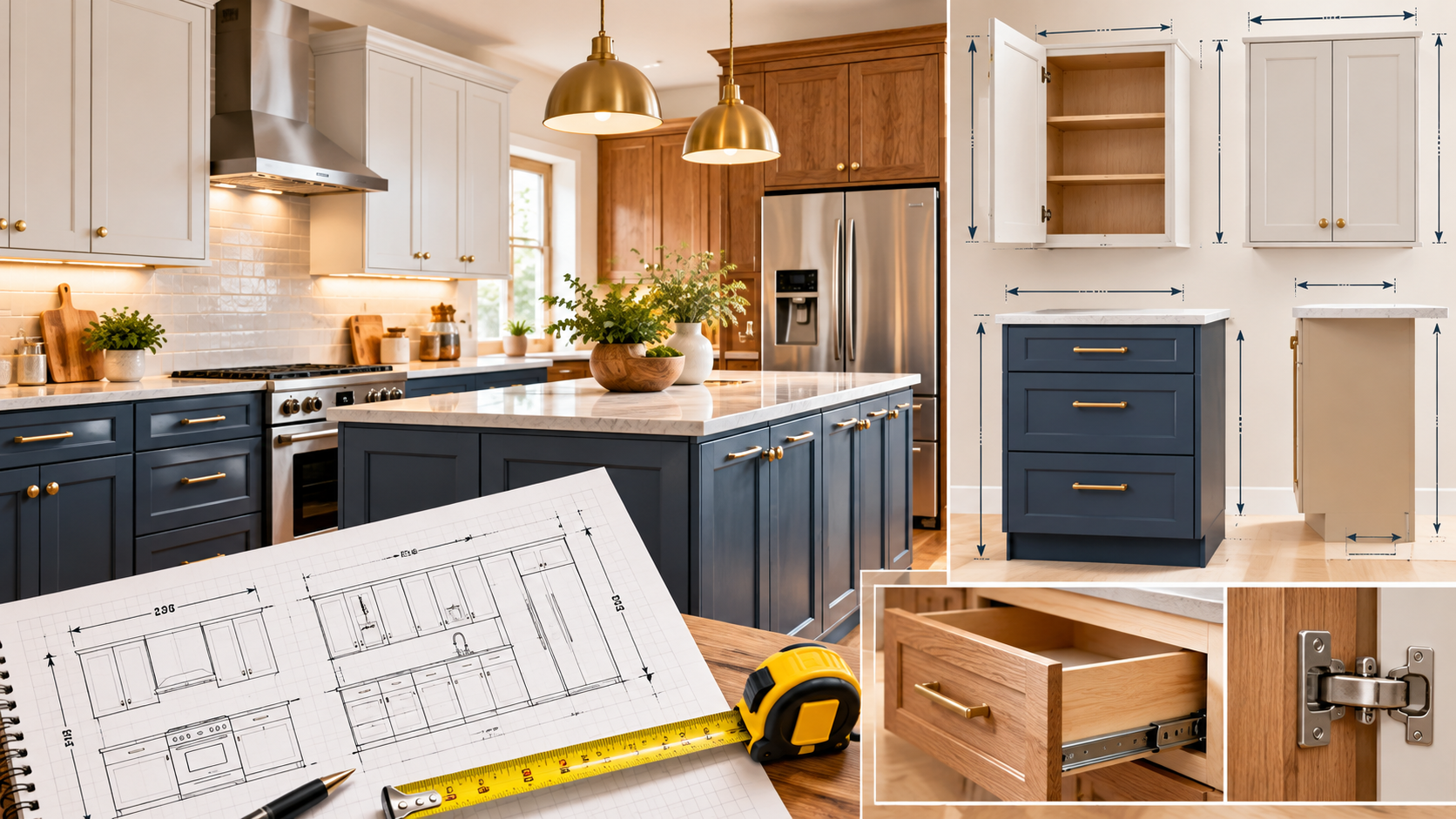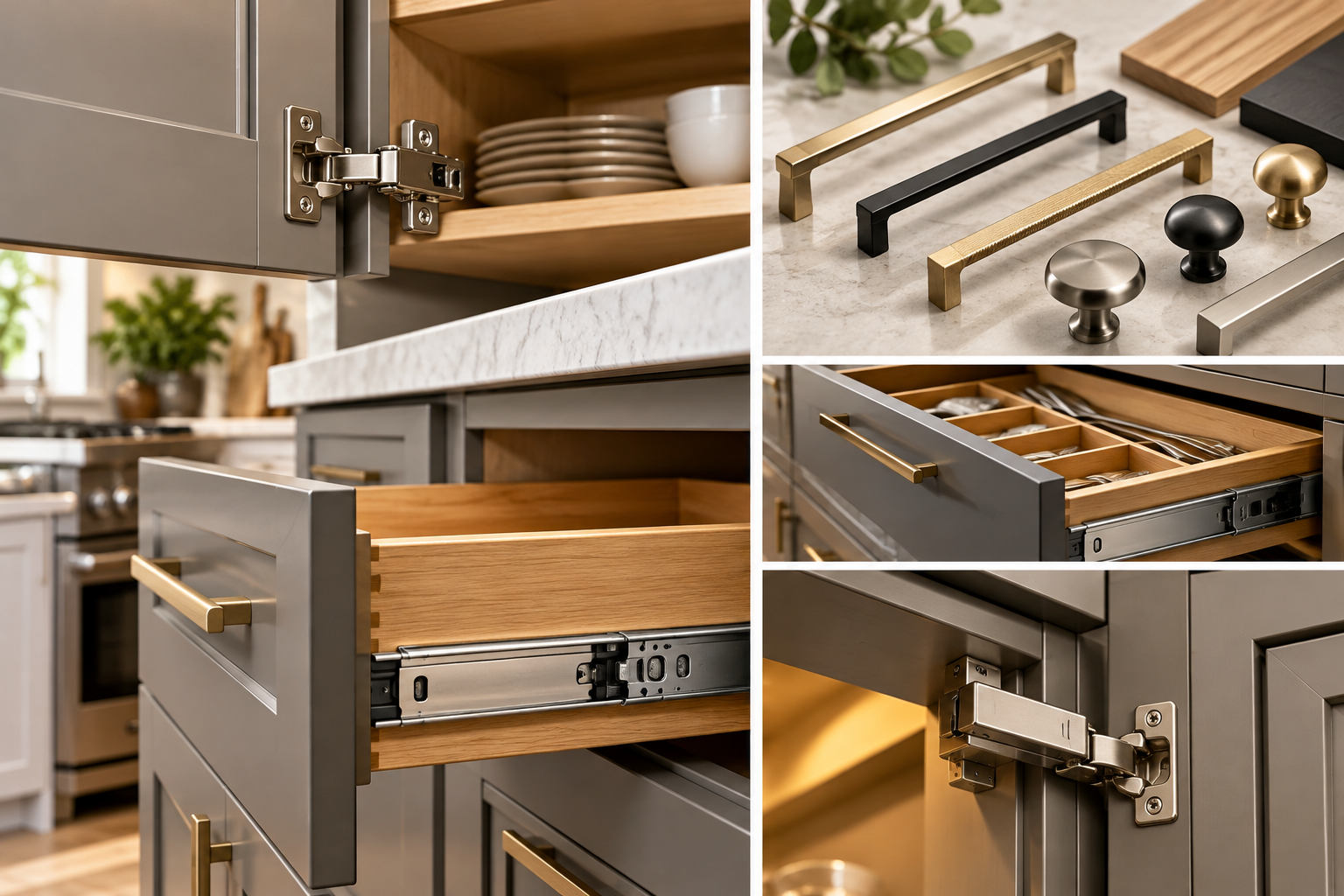

Kitchen cabinet hardware plays an important role in how cabinets function, feel, and perform over time. While cabinet doors, finishes, and layouts often receive the most attention during a kitchen project, hinges, drawer slides, and pulls influence everyday usability and installation requirements.
For contractors, builders, remodelers, and cabinet dealers, understanding these components helps with product selection, specification reviews, budgeting, and communication with clients.
This guide explains the main types of kitchen cabinet hardware, what to consider when choosing each component, and how to verify hardware specifications before placing a cabinet order.
What Is Kitchen Cabinet Hardware?
Kitchen cabinet hardware includes the mechanical and decorative components used to open, close, support, and operate cabinets and drawers.
The main categories include:
-
- Cabinet hinges: Connect cabinet doors to the cabinet box or face frame.
- Drawer slides: Support drawers and guide their movement.
- Knobs and pulls: Provide a grip for opening doors and drawers.
- Soft-close mechanisms: Slow the closing movement to reduce slamming.
- Specialty hardware: Includes pull-out organizers, waste-bin systems, tray dividers, and other functional accessories.
The appropriate hardware depends on cabinet construction, door and drawer design, intended use, product specifications, and project budget. Hardware should therefore be considered during cabinet selection rather than treated as an afterthought.
1. Types of Kitchen Cabinet Hinges
Cabinet hinges determine how doors open, how they align with the cabinet, and how much access is available to the cabinet interior.
Concealed Hinges
Concealed hinges are hidden when the cabinet door is closed. They are widely used in contemporary cabinetry because they create a clean exterior appearance.
Many concealed hinges offer adjustment in multiple directions, allowing installers to fine-tune door alignment. The available adjustment range and opening angle vary by hinge model.
When specifying concealed hinges, verify:
- Compatibility with the cabinet construction.
- Required hinge cup and mounting dimensions.
- Door overlay or inset configuration.
- Opening angle and nearby obstructions.
- Adjustment options.
- Whether soft-close functionality is included.
Exposed and Semi-Concealed Hinges
Exposed hinges remain visible when cabinet doors are closed, while semi-concealed hinges reveal part of the hinge.
These options may be appropriate for traditional, decorative, or specialty cabinet designs where the hardware contributes to the overall appearance.
Confirm that the selected hinge is compatible with the door, cabinet frame, and intended opening direction.
Soft-Close Hinges
Soft-close hinges slow the final movement of a cabinet door, helping prevent it from slamming shut.
This feature can improve the everyday user experience and may be particularly valuable in kitchens with frequent use. However, soft-close functionality is not identical across all products.
Before including it in a specification, verify whether the feature is integrated into the hinge or supplied through a separate mechanism.
Overlay and Inset Compatibility
Cabinet door positioning affects hinge selection.
-
- Full-overlay doors cover most of the cabinet face frame or cabinet edge.
- Partial-overlay doors leave more of the face frame visible.
- Inset doors sit within the cabinet frame opening.
Each configuration may require different hinge geometry and mounting arrangements. Never assume that a hinge suitable for one door configuration will automatically work with another.
For additional context, see our guide to kitchen cabinet door styles.
2. Types of Kitchen Cabinet Drawer Slides
Drawer slides support the drawer box and determine how it travels in and out of the cabinet.
Choosing the right slide involves more than selecting a preferred opening mechanism. Load capacity, cabinet construction, drawer dimensions, and the required extension all matter.
Side-Mount Drawer Slides
Side-mount slides attach to the sides of the drawer box and cabinet interior. Depending on the model, they may be available in different extension lengths and load ratings.
Some designs are easier to access for inspection or replacement because the slide is visible when the drawer is removed. Consider the available drawer width, required clearance, rated capacity, and mounting instructions before specifying side-mount slides.
Undermount Drawer Slides
Undermount slides are installed beneath the drawer box, keeping most of the mechanism out of sight when the drawer is open.
They can create a clean appearance and are commonly paired with contemporary cabinetry. Their installation requirements may be more specific than those of some side-mount systems.
Verify the required drawer-box dimensions, locking devices, clearances, and compatibility with the selected cabinet line.
Full-Extension Slides
Full-extension slides allow a drawer to travel far enough outward to provide access to most of its interior.
This can be useful for deep drawers, cookware storage, and other applications where access to items at the back matters.
The exact extension and load rating depend on the product. Check the manufacturer’s specifications rather than assuming that every slide described as full-extension has identical performance.
Soft-Close Drawer Slides
Soft-close drawer slides slow the drawer as it reaches the closed position. They can reduce slamming and improve perceived quality, particularly in kitchens where drawers are used frequently.
When comparing options, confirm whether soft-close is included as standard, available as an upgrade, or supplied through a separate component.
3. Cabinet Knobs and Pulls: Style Meets Function
Knobs and pulls are visible hardware components that affect both the appearance and usability of a kitchen.
Cabinet Knobs
Knobs are compact and commonly installed on cabinet doors. They are available in a wide range of shapes, materials, and finishes.
Their suitability depends on the door design, the user’s grip preference, and the overall style of the kitchen.
Cabinet Pulls
Pulls provide a larger gripping area and are often used on drawers and cabinet doors.
Common configurations include bar pulls, cup pulls, and more decorative designs. The selected size should be proportionate to the cabinet front and comfortable to use.
Choosing Hardware Finishes
Hardware finishes should coordinate with cabinet finishes, faucets, lighting, and other visible details.
Common choices include brushed nickel, matte black, chrome, brass tones, and bronze finishes. The best choice depends on the overall design rather than a single universal rule.
For projects with multiple kitchens, standardizing hardware selections can simplify specifications and make ordering more consistent.
Before finalizing the selection, confirm the exact finish and product availability with the relevant supplier.
4. Specialty Cabinet Hardware and Storage Accessories
Some cabinet projects require hardware beyond standard hinges, slides, knobs, and pulls.
Examples include:
- Pull-out waste and recycling bins.
- Tray dividers and vertical storage organizers.
- Pull-out pantry systems.
- Corner-cabinet accessories.
- Drawer organizers.
- Soft-close mechanisms and replacement components.
These features can improve storage accessibility, but they may also affect cabinet dimensions, usable interior space, and installation requirements.
Confirm that each accessory is compatible with the selected cabinet size and configuration. Where an accessory requires a particular cabinet width or depth, verify the product specifications before ordering.
5. How to Choose the Right Hardware for a Kitchen Project
For contractors and builders, hardware selection should follow a repeatable process.
Step 1: Confirm Cabinet Construction
Determine whether the cabinets are framed or frameless. The construction can influence hinge mounting, drawer-slide compatibility, and available hardware options.
Step 2: Verify Door and Drawer Specifications
Review door overlay, inset requirements, drawer-box dimensions, and the intended opening direction.
These details help determine which hardware components are compatible with the cabinetry.
Step 3: Define Functional Requirements
Identify the features the project actually needs.
For example, a high-use kitchen may benefit from soft-close mechanisms, while a specialty storage cabinet may require a particular pull-out accessory.
Avoid adding features without confirming their compatibility and value for the project.
Step 4: Compare Specifications
Review the manufacturer’s documentation for:
- Load ratings and permitted applications.
- Mounting requirements.
- Opening angles and extension lengths.
- Adjustment options.
- Soft-close functionality.
- Finish and corrosion-resistance information, where applicable.
- Warranty terms and exclusions.
Do not compare hardware solely by appearance or price. The specifications should match the intended use.
Step 5: Verify Availability and Lead Times
Before committing to a project schedule, confirm the availability of the selected cabinet line and any required hardware or accessories.
If a project includes multiple kitchens, make sure the selected components can be specified consistently across the required quantities.
For related planning considerations, see our standard kitchen cabinet sizes and measuring guide.
6. Common Kitchen Cabinet Hardware Selection Mistakes
Choosing Hardware Before Confirming Compatibility
A hinge or drawer slide may look suitable but still be incompatible with the cabinet construction or dimensions.
How we avoid this: We verify hardware requirements against the cabinet line’s specifications before finalizing product selections.
Assuming Soft-Close Is Always Included
Soft-close functionality varies between product lines and models.
How we avoid this: We confirm whether the feature is standard, optional, or supplied separately.
Overlooking Drawer Clearances
Drawer slides require specific clearances, and drawer-box dimensions can vary by construction.
How we avoid this: We check the applicable installation documentation and cabinet specifications before ordering.
Forgetting Specialty Accessories
Panels, organizers, pull-out systems, and other components can be missed when the order focuses only on cabinet boxes.
How we avoid this: We compare the final cabinet schedule with the selected accessories and required finishing components.
Mixing Incompatible Hardware Specifications
Using different components without checking compatibility can create installation problems and inconsistent performance.
How we avoid this: We verify the required hardware against the selected cabinet products and document the relevant specifications.
7. Kitchen Cabinet Hardware Checklist for Contractors
Before finalizing a cabinet order, review the following:
- Cabinet construction and door configuration have been confirmed.
- Hinge types are compatible with the doors and cabinet frames.
- Overlay or inset requirements have been verified.
- Drawer-slide types, dimensions, and load ratings have been checked.
- Soft-close requirements have been documented.
- Knobs, pulls, and finishes have been selected.
- Required storage accessories have been included.
- Hardware quantities match the cabinet schedule.
- Product availability and lead times have been confirmed.
- Manufacturer specifications and applicable warranty information have been reviewed.
A consistent checklist can help reduce omissions, support clearer supplier communication, and improve coordination between cabinet selection and installation.
Final Thoughts
Kitchen cabinet hardware has a direct influence on cabinet functionality, installation requirements, and the finished kitchen experience. Selecting suitable hinges, drawer slides, pulls, and storage accessories requires careful attention to compatibility and product specifications.
For contractors, builders, remodelers, and cabinet dealers, a consistent hardware review process can help reduce ordering errors and support smoother project coordination.
NextDAY Cabinets supplies kitchen cabinetry and related products for trade professionals. Explore our kitchen cabinet options or contact our team to discuss cabinet requirements for your next project.
Frequently Asked Questions
What is the difference between a cabinet hinge and a drawer slide?
A cabinet hinge connects a door to the cabinet and controls its opening movement. A drawer slide supports a drawer and guides it as it moves in and out.
Are soft-close hinges and soft-close drawer slides the same?
No. Soft-close hinges control the closing movement of cabinet doors, while soft-close drawer slides control the closing movement of drawers. Each component must be selected for its intended application.
Are undermount drawer slides better than side-mount slides?
Neither option is universally better. Undermount slides conceal more of the mechanism, while side-mount slides may offer different installation and service characteristics. The appropriate choice depends on cabinet design, dimensions, load requirements, budget, and product compatibility.
Can any hinge be used with any cabinet door?
No. Hinge compatibility depends on the cabinet construction, door overlay or inset configuration, mounting requirements, and the hinge’s specifications.
What should contractors verify before ordering cabinet hardware?
Contractors should confirm compatibility, dimensions, load ratings, opening requirements, finish, included features, quantities, availability, and relevant manufacturer documentation.