How to Become a Cabinet Dealer in Maryland, Virginia and Illinois

To become a cabinet dealer you need four things: a registered business, a resale certificate for your state, a wholesale supplier account, and somewhere to show product. In most cases there is no specialist cabinet licence.
That last point surprises people, and it is the reason the barrier to entry is lower than most assume. What actually separates a dealership that works from one that stalls is supplier choice and lead time management, not licensing.
This guide covers what a dealer actually does, what it costs to start, whether you need a showroom, how margins work, and how to choose between a distributor and a manufacturer.
Table of Contents
ToggleWhat does a cabinet dealer actually do?
A dealer sits between a wholesale distributor and the end customer. The work is sales, design consultation, ordering, and coordinating delivery and often installation.
Three models dominate, and they need different things from a supplier.
Design-led. The dealer sells through consultation, usually to homeowners, with a design service as the entry point. Needs broad brand and finish range, strong design support, and samples to show. Volume is lower and margin per job is higher.
Volume-to-contractors. The dealer supplies builders, remodellers and property managers who already know what they want. Needs stock depth, short lead times and reliable delivery far more than it needs finish variety. Margin per job is thinner and repeat volume carries it.
Installation-inclusive. The dealer sells, supplies and installs. Highest revenue per job and the most operational complexity, since it adds labour, scheduling, insurance and contractor licensing to the business.
Most dealers end up in a blend of the first two. The third is a different business with cabinets attached.
 Do you need a licence to sell cabinets?
No specialist cabinet licence exists in most states. What you do need:
- A registered business entity. Sole proprietorship, LLC or corporation. All three work.
- A resale certificate, sometimes called a sales tax exemption certificate. This is what allows you to buy wholesale without paying sales tax, because your customer pays it instead. It is the item new dealers most often lack.
- A local business licence or permit, which varies by county and municipality.
- Contractor licensing, if you install. Selling cabinets and installing them are treated differently, and the moment you fit them yourself you are into contractor licensing territory.
Requirements differ across the three states and they change, so check the authority rather than a blog post:
- Maryland: Maryland Business Express for registration, and the Comptroller for the resale certificate
- Virginia: the State Corporation Commission for registration, and the Department of Taxation for the exemption certificate
- Illinois: the Illinois Secretary of State for registration, and the Department of Revenue for the resale certificate
Each issues resale certificates through its revenue department, and they are normally free.
What does it cost to start?
An honest range, and a note on what is genuinely optional.
| Item | Typical cost | Notes |
|---|---|---|
| Business registration | $50 to $500 | Varies by state and entity type |
| Resale certificate | $0 to $50 | Usually free |
| Local business licence | $50 to $400 | County or municipal |
| Liability insurance | $500 to $1,500/yr | Required by many suppliers |
| Sample doors and finishes | $300 to $1,500 | Some suppliers provide free or at cost |
| Design software | $0 to $2,400/yr | Free if the supplier provides design support |
| Website and basic marketing | $500 to $5,000 | Wide range depending on approach |
| Showroom lease | $0 to $40,000/yr | Optional at start, see below |
| Initial inventory | $0 to $30,000 | Optional with a stocking distributor |
| **Realistic home-based start** | **$1,500 to $8,000** | Excludes showroom and inventory |
Inventory is the largest avoidable cost. A dealer who buys stock upfront ties capital into product that may not match what sells. A dealer working with a stocking distributor orders against a confirmed job and pays for what is already sold. For a new dealership, that difference frequently decides whether the business survives its first slow quarter.
 Do you need a showroom to start?
No, and starting with one is usually a mistake.
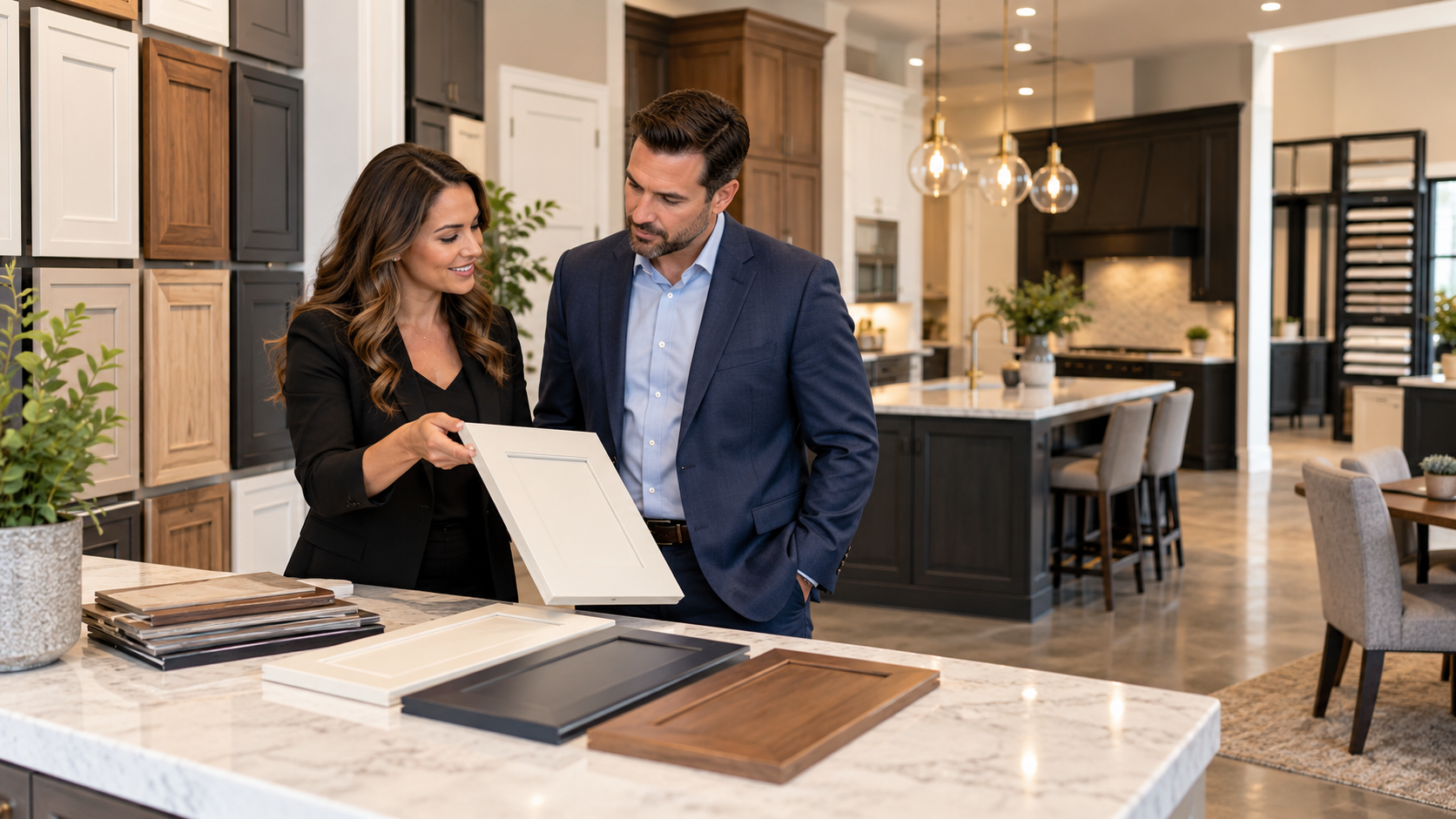
Many dealers begin from a home office. What they need is not a showroom of their own but access to one, plus a set of sample doors they can put in front of a client.
Taking a client to a distributor’s showroom does the job a showroom does. The client sees full door displays, opens drawers, compares finishes under real light, and gets a designer in the room. The dealer gets all of that without a lease, fit-out, staffing or utilities.
This is a genuine structural advantage of working with a distributor that has showrooms, and it is worth stating plainly rather than dressing up. A showroom is a fixed cost that has to be carried in slow months. Deferring it until volume justifies it is the more survivable path.
Where a showroom starts to earn its place: when walk-in traffic becomes a meaningful lead source, when you carry enough volume that supplier displays no longer cover your range, and when your market expects a physical presence.
How cabinet dealer margins work
Cabinet pricing runs on a list price with a multiplier applied.
Every manufacturer publishes a list price per cabinet. A distributor buys at a multiplier off that list. A dealer buys from the distributor at a different multiplier, then sells to the end customer at whatever the market supports.
When a distributor quotes “50 off list,” they mean you pay half the published list price.
Volume tiers. Most distributors operate discount tiers based on either per-order value or annual cumulative spend. Annual cumulative rewards consolidating your buying with one supplier. Per-order rewards larger individual jobs.
Why factory-direct distributors price lower than retail showrooms. A retail showroom carries the cost of the space, the sales floor and the display inventory, and that cost is in the price. A distributor selling to trade carries less of it. That gap is the room a dealer operates in.
What erodes margin, in the order it usually happens:
- Freight, particularly on small orders where the delivery cost is a large share of the order value
- Damage and remakes, which cost you time and goodwill even when the supplier replaces free
- Lead time overruns, which push a crew, delay a draw, and occasionally cost you a job
- Quoting errors, most often a missed filler, end panel or moulding line
- Change orders absorbed rather than charged, which is the most common self-inflicted margin loss
The dealers who hold margin are usually the ones who quote from a complete schedule rather than a rate, and who charge for changes.
 Choosing a cabinet supplier: what to check
A checklist worth taking to every supplier you consider.
- Lead time from stock and from order. Ask for both, and ask what happens when an item is out of stock.
- Inventory depth. How much is genuinely held versus ordered on demand.
- Brand range on one account. Multiple brands from a single account means one relationship, one delivery, one invoice.
- Damage and remake policy. How fast a replacement door arrives, and who pays freight. Ask for the actual turnaround, not the policy wording.
- Delivery radius and terms. Job site delivery or dock pickup. Lift gate availability. Whether they place inside.
- Design support. Whether layout and takeoff help is included, and at what cost.
- Minimum order. Some suppliers have none on stocked items, others carry a manufacturer minimum on made-to-order lines.
- Whether they also sell retail. This is the one most new dealers miss. A distributor that sells retail to homeowners is competing against its own dealers on the same product.
- A named account contact. Someone who knows your business is worth more than a general line at four in the afternoon.
Distributor or manufacturer: which should you partner with?
Both models work, and they suit different dealerships.
| Manufacturer | Distributor | |
|---|---|---|
| Brands available | One | Multiple on one account |
| Territory | Often exclusive | No exclusivity |
| Brand marketing support | Usually provided | Limited |
| Lead time | Longer, made to order | Faster from stocked inventory |
| Deliveries | One per brand | One covering all brands |
| Product breadth | Single line, deep | Multiple lines, broad |
| Minimum commitment | Often an annual volume target | Frequently none |
| Pricing | Best on high volume in one line | Better on mixed and moderate volume |
Where a manufacturer partnership genuinely wins. If you are doing high volume in one product line, an exclusive territory is worth real money and the direct pricing at volume is difficult for a distributor to match. Brand marketing support and co-op advertising are also meaningful for a dealer building around a single recognised name.
Where a distributor wins. Mixed volume, varied client requirements, and any dealership where the specification changes job to job. One account covering several brands means you can answer a client’s question without opening a new supplier relationship, and stocked inventory means a fast job stays fast.
Most dealers start with a distributor and add a direct manufacturer relationship later if one line comes to dominate their volume.
Step by step: opening your cabinet dealership
- Register the business. Choose an entity type and register with your state. Straightforward and usually online.
- Obtain a resale certificate from your state revenue department. This is what makes wholesale purchasing tax-exempt.
- Get liability insurance. Many suppliers require proof before opening an account.
- Research your local market. Who is already selling, at what level, and where the gap is. A market saturated at the design-led end may be wide open for contractor supply.
- Choose a supplier and open a trade account. Use the checklist above. Open the account before you need it, since setup takes time you will not have when a job appears.
- Select display samples. A modest set of door styles and finishes covering the range you intend to sell. Resist buying broadly at the start. Worth knowing which lines carry ANSI/KCMA A161.1 certification, since it gives you a performance benchmark to quote rather than a vague quality claim, and certification varies by manufacturer and product line.
- Set your pricing. Work from the schedule, not a rate. Decide your markup by job type and hold it.
- Build a lead source. Referral relationships with contractors, a Google Business Profile, and a basic website. In most markets, contractor relationships out-produce advertising for a new dealer.
- Take the first order. Quote it completely, order early, and over-communicate on timing.
The step new dealers most often skip is the fifth one. Opening an account after winning a job means the account setup, the design and the lead time all stack, and the client experiences all of it as your delay.
Opening a trade account with NextDAY Cabinets
The commercial part, stated plainly.
We are a wholesale distributor supplying contractors, dealers and builders across Virginia, Maryland and the Chicago metro. Account setup is same-day in most cases.
Multiple brands on one account, so you can answer a client’s question about door style or price point without opening another supplier relationship.
Stocked inventory with short lead times, which is what allows a fast job to stay fast rather than waiting on a factory run.
Free 3D design support through our professional design services team, which removes the design software cost from your startup budget.
Showrooms you can bring clients to in Virginia, Maryland and Illinois, so you do not need one of your own to start.
We do not sell retail. Dealers are not competing against their own supplier for the same customer, which is not true of every distributor and is worth checking wherever you buy.
You can open a trade account online, and our delivery page covers pickup and delivery from each location.
Which NextDAY showroom serves your market?
| Showroom | Region served |
|---|---|
| Chantilly, VA | Fairfax County, Loudoun, western Northern Virginia |
| Alexandria, VA | Alexandria, Arlington, Springfield, inner Northern Virginia |
| Woodbridge, VA | Prince William County, Dale City, Lake Ridge, Manassas |
| Richmond, VA | Richmond metro, Short Pump, Glen Allen, central Virginia |
| Beltsville, MD | Prince George’s, Montgomery, Howard counties, DC |
| Chicago, IL | Chicago metro and surrounding suburbs |
Frequently asked questions
Do I need a licence to become a cabinet dealer?
No specialist cabinet licence exists in most states. You need a registered business, a resale certificate for tax-free wholesale purchasing, and a local business licence. If you also install, contractor licensing applies and requirements differ by state.
How much does it cost to start a cabinet dealership?
A realistic home-based start runs $1,500 to $8,000, covering registration, insurance, samples and basic marketing. That excludes a showroom lease and inventory, both of which are optional when your distributor holds stock. Inventory is the largest avoidable cost for a new dealer.
Can I run a cabinet dealership from home?
Yes, and most new dealers do. What you need is sample doors and access to a supplier’s showroom for client visits, rather than a showroom of your own. Deferring the lease until volume justifies it is the more survivable route.
What is a resale certificate and why do I need one?
A resale certificate, issued by your state revenue department, allows you to purchase wholesale without paying sales tax, because your end customer pays it instead. Suppliers require one to sell to you at trade pricing. It is normally free to obtain.
How long does it take to open a cabinet dealership?
Business registration and a resale certificate typically take days to a few weeks depending on the state. A trade account can often be opened same-day once those are in place. The realistic answer is two to six weeks from decision to first order, and the delay is usually state paperwork rather than the supplier.
Can contractors and interior designers become cabinet dealers?
Yes, and both are common. Contractors frequently add a dealership to capture the cabinet margin on work they were already specifying. Designers add it to control the supply chain on projects they design. Both already have the client relationships, which is the hardest part.
What is the difference between a cabinet dealer and a cabinet distributor?
A distributor buys from manufacturers and sells wholesale to trade. A dealer buys from a distributor and sells to end customers, adding design, coordination and often installation. A distributor that also sells retail is competing with its own dealers.
How do I open a trade account with NextDAY Cabinets?
Apply online with your business registration and resale certificate. Setup is same-day in most cases, and you can then order from stocked inventory or place a made-to-order line.
Getting started
The paperwork is the easy part and it is where most people stall. Register the business, get the resale certificate, and open the supplier account before you need it rather than after you have won a job.
The decision that matters more is the supplier. Lead time, stock depth, remake turnaround and whether they compete with you at retail will affect your margins and your reputation more than the multiplier on the invoice.
Trade professionals across Virginia, Maryland and the Chicago metro can open a trade account with us, browse the full product range, or get in touch with questions before applying.