
Kitchen Cabinet Cost in 2026: Real Prices Per Linear Foot
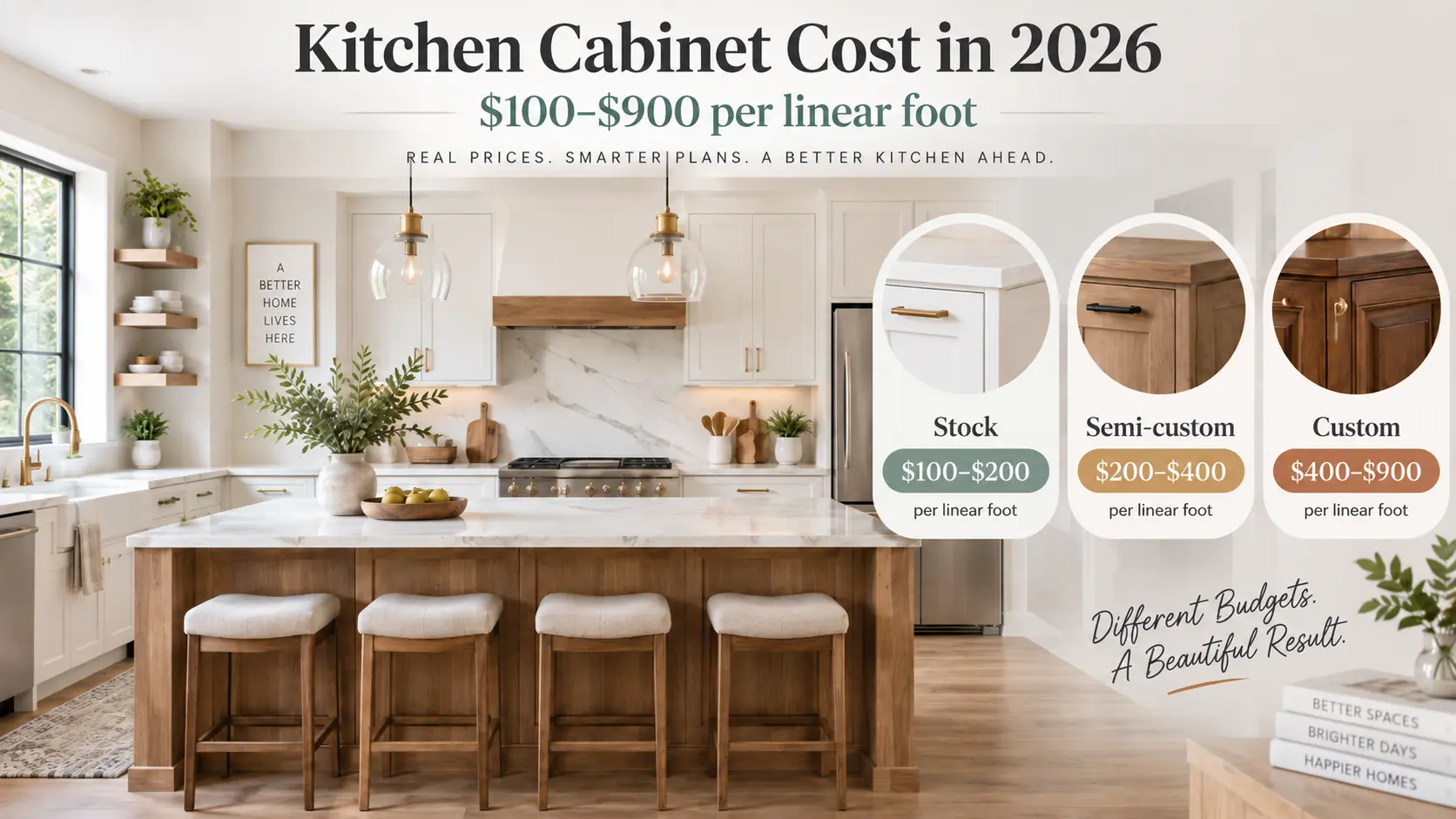
Kitchen cabinets run roughly $100 to $900 per linear foot in 2026, and where you land inside that has almost nothing to do with brand prestige.
The spread is driven by three things: the tier you buy, the material the box and door are made from, and the finish. A well-made semi-custom cabinet in a standard paint costs less than a mediocre custom cabinet in a specialty finish, and the badge on the door tells you very little either way.
This page gives real price bands per linear foot by tier, three worked examples by kitchen size, and an estimator. Installation is priced separately and covered in its own section.
What kitchen cabinets cost in 2026 (quick answer)
| Tier | Cost per linear foot | Typical 10×10 kitchen | What you get |
|---|---|---|---|
| Stock | $100 to $200 | $2,000 to $4,000 | Fixed sizes, limited finishes, fastest |
| Semi-custom | $200 to $400 | $4,000 to $8,000 | Standard boxes, wide finish and door range, some modifications |
| Custom | $400 to $900 | $8,000 to $18,000 | Built to your dimensions, any finish, full modification |
Figures are for cabinets only. Countertops, appliances, delivery and installation are separate.
What moves a project from one band to the next is rarely size. It is door style and finish first, box construction second, and modifications third.
What “per linear foot” includes, and what it hides
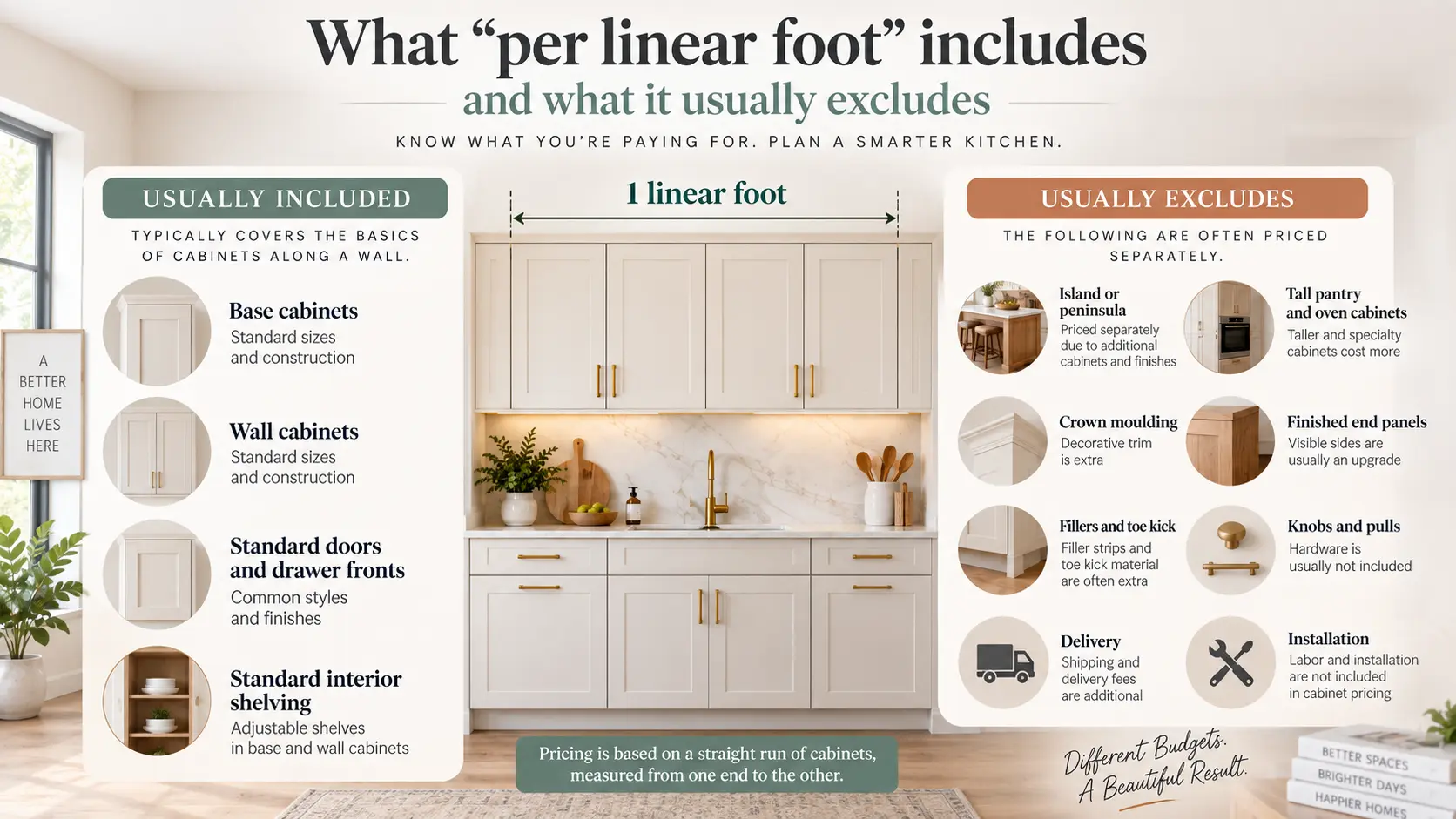 A linear foot measures the run of cabinetry along a wall. The industry convention assumes a standard mix: roughly one base cabinet and one wall cabinet per foot of run.
That convention is useful for comparing quotes and dangerous for setting a budget, because of what it leaves out.
| Usually included | Usually excluded |
|---|---|
| Base cabinets | Island or peninsula |
| Wall cabinets | Tall pantry and oven cabinets |
| Standard doors and drawer fronts | Crown and light rail moulding |
| Standard interior shelving | Finished end panels |
| Filler strips and scribe moulding | |
| Toe kick | |
| Knobs and pulls | |
| Delivery | |
| Installation |
A worked example of the gap
A homeowner is quoted $250 per linear foot for a 20 foot kitchen. They budget $5,000.
The final cabinet invoice:
| Line | Cost |
|---|---|
| 20 linear feet at $250 | $5,000 |
| Island, 8 feet of base cabinets | $1,400 |
| Tall pantry cabinet, 24 inch | $780 |
| Crown moulding, 26 feet | $420 |
| Finished end panels, 4 | $560 |
| Fillers, toe kick, scribe | $210 |
| Hardware, 32 pieces | $290 |
| Delivery | $250 |
| Cabinet total | $8,910 |
Nothing in that list is a surprise charge. Every item is standard, and none of it is in the per-linear-foot figure. The gap is 78 percent, and it is the single most common budget failure in a kitchen project.
The fix is straightforward: ask for a quote against a cabinet schedule rather than a linear foot rate. It is the only way to compare two suppliers honestly.
Stock, semi-custom and custom: what each tier actually buys
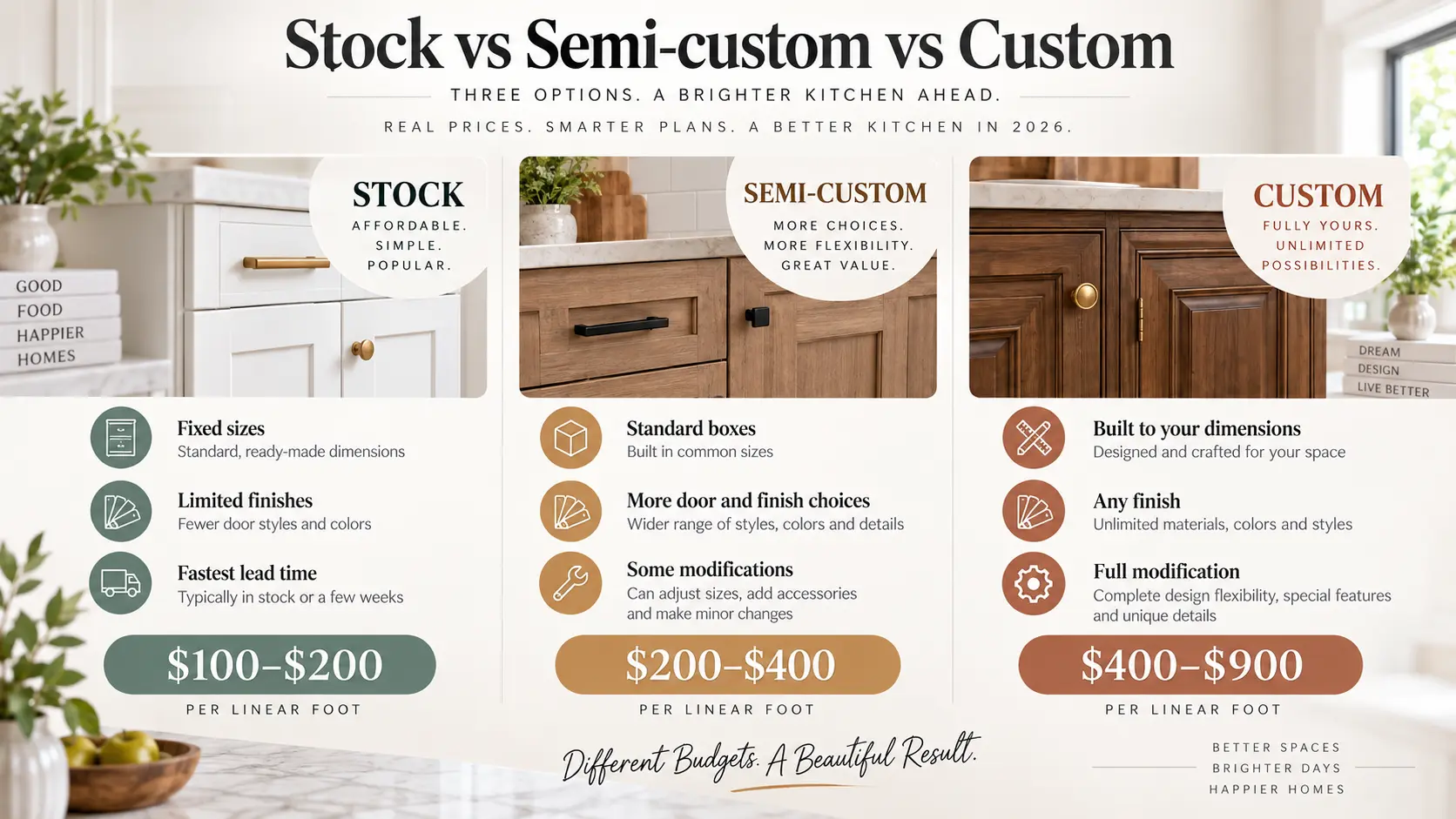 Forget the quality language. The tiers differ on five measurable things.
| Stock | Semi-custom | Custom | |
|---|---|---|---|
| Size increments | 3 in, fixed | 3 in, some modification | Any dimension |
| Box construction | Often particleboard | Plywood commonly available | Plywood standard |
| Door styles | 3 to 8 | 15 to 40 | Unlimited |
| Finish options | 4 to 10 | 20 to 60 | Any, including matched |
| Modifications | None | Depth, height, some width | Anything |
| Lead time | Days to 2 weeks | 4 to 8 weeks | 8 to 16 weeks |
| Per linear foot | $100 to $200 | $200 to $400 | $400 to $900 |
The jump from stock to semi-custom buys more than the jump from semi-custom to custom. That is the most useful thing on this page.
Moving from stock to semi-custom typically gets you a plywood box instead of particleboard, dovetailed drawers instead of stapled, soft-close hardware as standard, and a finish range wide enough that you are choosing rather than settling. That is a material change in how the kitchen performs and how long it lasts.
Moving from semi-custom to custom mostly buys dimensional freedom. If your walls are close to standard and the layout is a rectangle, you may be paying a large premium for filler panels you would not have needed anyway. If the room is irregular, has a sloped ceiling, or has a run that lands awkwardly between standard sizes, custom earns it.
Box construction is where the long-term difference sits, and it is covered in our guide to cabinet box construction.
What drives the price up, in order of impact
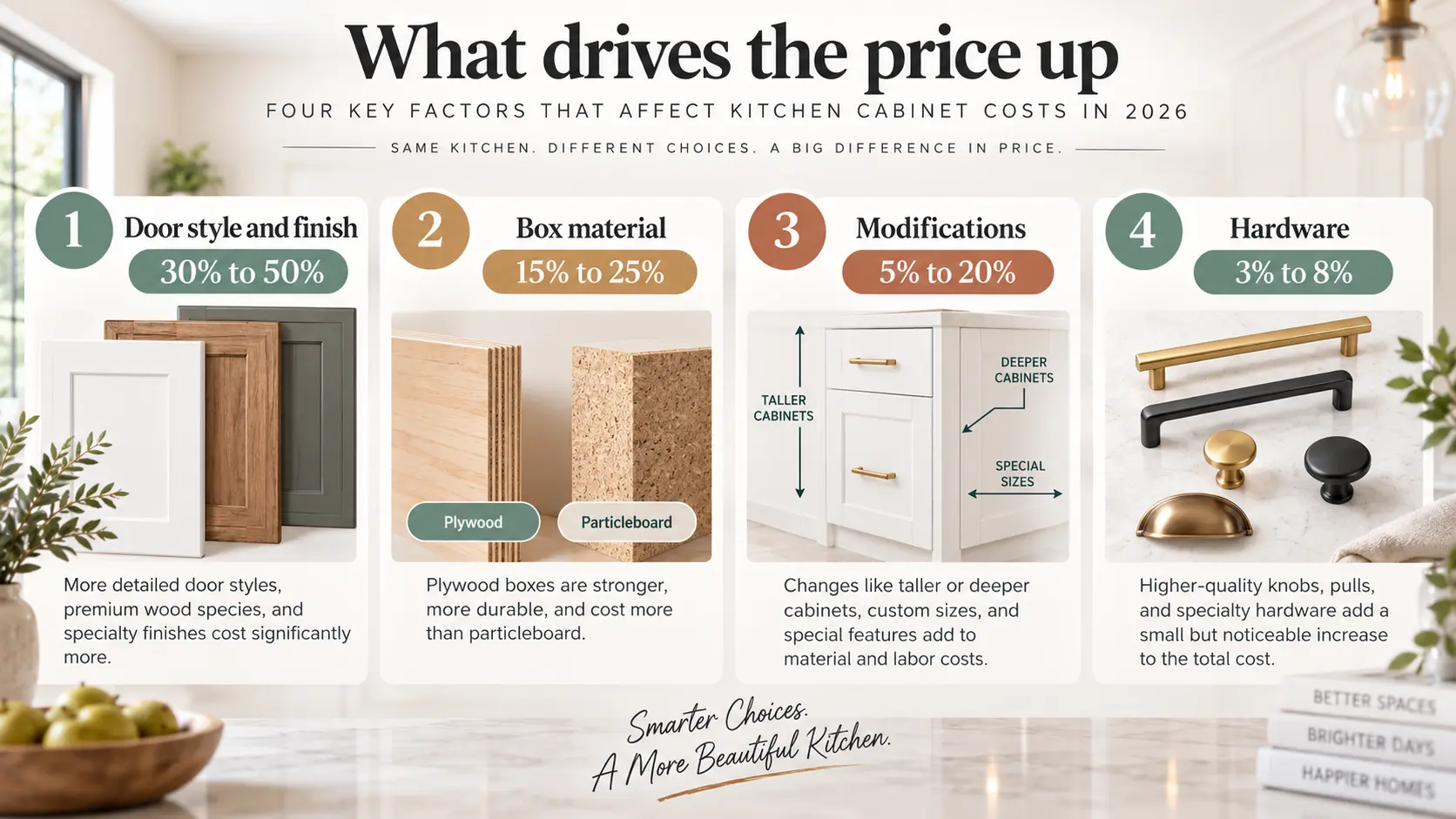 Ranked by what actually moves the number.
1. Door style and finish, 30 to 50 percent
The largest driver and the one people underestimate.
A painted finish costs more than a stained one on the identical door, typically 10 to 20 percent. The reason is process rather than material: paint requires more preparation, more coats, more cure time and shows every imperfection, so the reject rate at the factory is higher. Stain is more forgiving because the grain hides minor variation.
Within painted finishes, a standard white sits at the bottom and a specialty or custom-matched colour at the top. Textured and glazed finishes sit above both.
Door style matters almost as much. A slab door uses the least material and labour. Shaker sits in the middle. A raised panel with detailed profiles sits highest, because there is more machining and more surface to finish.
| Choice | Impact vs baseline |
|---|---|
| Stained slab door | Baseline |
| Stained shaker | +5 to 10% |
| Painted shaker, standard white | +15 to 25% |
| Painted shaker, custom colour | +25 to 35% |
| Painted raised panel | +30 to 45% |
| Glazed or textured specialty | +40 to 60% |
2. Box material, 15 to 25 percent
Plywood versus particleboard. Plywood costs more, holds screws better, resists sagging under load and survives moisture. In a kitchen, the cabinet bottom under the sink is where the difference shows up, usually around year eight.
A useful benchmark when comparing lines: the ANSI/KCMA A161.1 certification programme tests doors and drawers through 25,000 cycles, wall cabinets under a 600 pound load, and shelves under load for seven days. Certification varies by manufacturer and product line, so ask about the specific line you are quoted rather than about the brand.
3. Modifications, 5 to 20 percent
Reduced depth, altered height, non-standard width. Each modification carries a charge and adds lead time. One or two is normal. A dozen suggests you should be pricing custom instead.
4. Hardware, 3 to 8 percent
Knobs and pulls are the cheapest visible upgrade in a kitchen. Soft-close hinges and full-extension slides are usually included at semi-custom and above, and worth specifying if they are not.
Cost by kitchen size: three worked examples
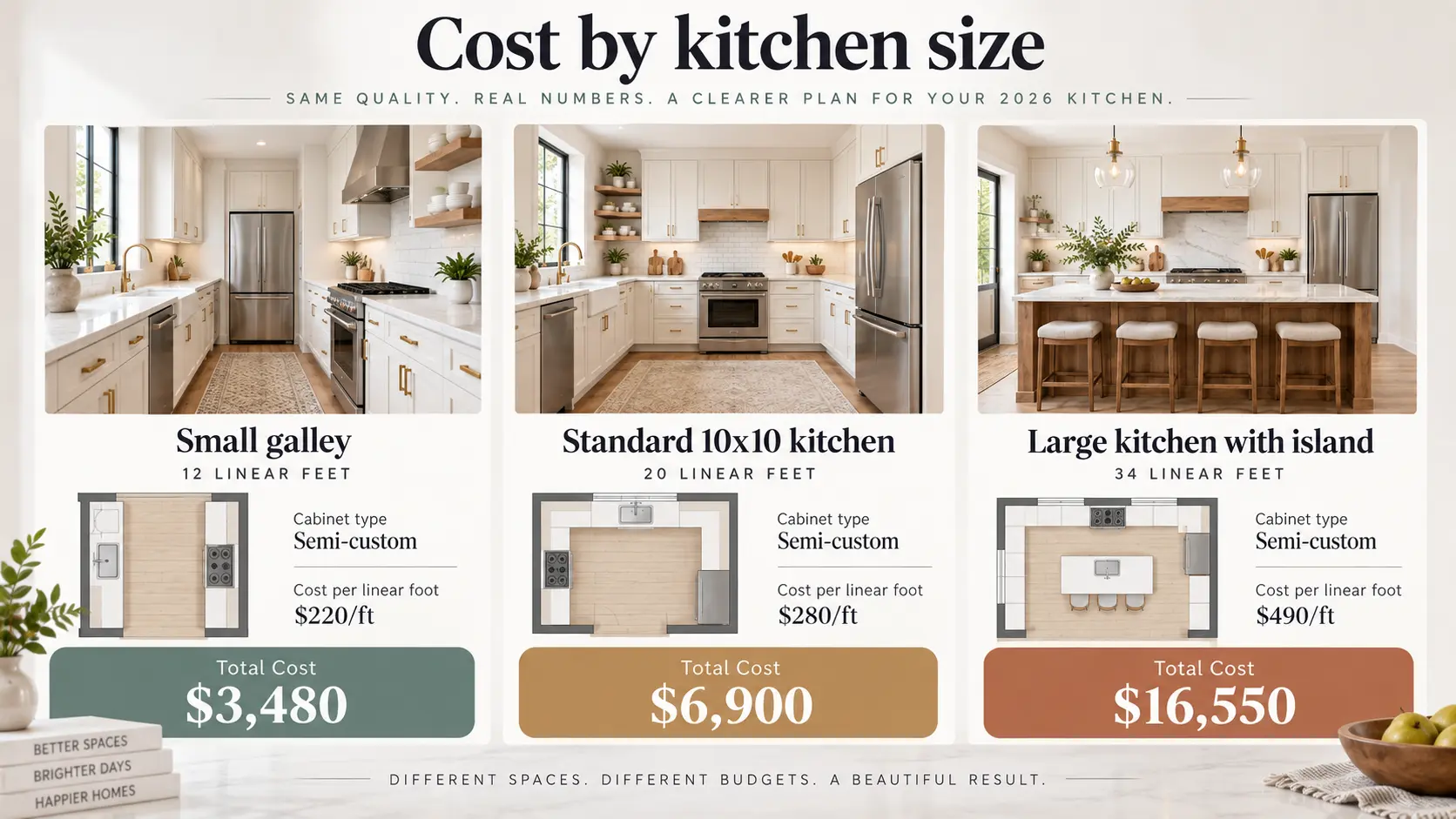 Real configurations rather than round numbers. All figures are cabinets only.
Small galley, 12 linear feet
Two facing runs in an apartment or a townhouse kitchen.
| Item | Detail | Cost |
|---|---|---|
| Base cabinets | 6 units, 12 to 36 in | $1,320 |
| Wall cabinets | 5 units, 30 in high | $980 |
| Sink base | 30 in | $340 |
| Crown and light rail | 18 ft | $290 |
| End panels | 2 | $240 |
| Fillers, toe kick | $130 | |
| Hardware | 22 pieces | $180 |
| Total, semi-custom at $220/ft | $3,480 |
Standard 10×10 kitchen, 20 linear feet
The industry reference configuration, an L-shape with a sink run and a range wall.
| Item | Detail | Cost |
|---|---|---|
| Base cabinets | 8 units | $2,240 |
| Wall cabinets | 7 units, 36 in high | $1,890 |
| Corner base with lazy susan | 36 in | $620 |
| Tall pantry | 24 in x 84 in | $780 |
| Crown and light rail | 28 ft | $450 |
| End panels | 3 | $420 |
| Fillers, toe kick, scribe | $210 | |
| Hardware | 34 pieces | $290 |
| Total, semi-custom at $280/ft | $6,900 |
Large kitchen with island, 34 linear feet
Open plan with a perimeter run, an island and a tall bank.
| Item | Detail | Cost |
|---|---|---|
| Perimeter base cabinets | 11 units | $3,850 |
| Wall cabinets | 9 units, 42 in high | $3,240 |
| Island base cabinets | 5 units, finished 4 sides | $2,600 |
| Tall pantry and oven cabinet | 2 units | $2,150 |
| Corner solutions | 2 pull-out units | $1,280 |
| Crown, light rail, trim | 46 ft | $890 |
| End and island panels | 7 | $1,540 |
| Fillers, toe kick, scribe | $380 | |
| Hardware | 58 pieces | $620 |
| Total, semi-custom at $490/ft | $16,550 |
Note what happens to the per-foot figure across the three. It rises with complexity rather than with size, because islands, tall units and finished panels all cost more per foot than a straight base run.
Cabinet cost estimator
[CALCULATOR WIDGET]
Inputs: linear feet of run, tier, island yes or no, tall cabinets, finish type. Output: estimated cabinet cost range with the exclusions listed.
For a manual estimate: multiply your linear feet by the tier rate, add 15 percent for trim, panels and fillers, then add separately for any island, tall cabinet or specialty finish.
Installation, priced separately
Cabinet installation in this region typically runs $80 to $200 per linear foot depending on complexity, and it is a separate line from the cabinets themselves.
What raises it: an island, tall cabinets requiring two installers, an out-of-square room needing extensive scribing, and removal and disposal of the existing kitchen.
What lowers it: a straightforward rectangular layout, a floor already level, and cabinets that arrive assembled rather than requiring on-site build.
A quote that presents cabinets and installation as one figure is difficult to compare. Ask for them itemised.
Where 2026 prices are heading
Two forces are acting on cabinet pricing, and they push in the same direction.
Tariff exposure on imported cabinetry and components. A substantial share of ready-to-assemble cabinetry and many components, including hardware, sold in the United States are imported. Tariff policy on those categories has been an active area of change, and where duties rise the cost passes through to the finished product within a quarter or two. Domestically manufactured lines are insulated on the box but not always on hardware, since slides and hinges are frequently imported regardless of where the cabinet is made.
Hardwood and plywood costs. These move with construction demand and with freight. The BLS producer price index for custom wood kitchen cabinets and related cabinetwork stood at 159.0 in January 2026 against a December 2012 base of 100, which puts the longer-term direction in context. They have been volatile rather than uniformly rising, and they affect solid wood doors and plywood boxes more than they affect painted MDF fronts.
The directional view, stated with the uncertainty it deserves: the pressure on 2026 pricing is upward rather than downward, and imported product carries more of that pressure than domestic. A project quoted now is more likely to cost the same or less than the same project quoted in six months. That is a directional judgement, not a forecast, and tariff policy in particular can change faster than any content page can track.
The practical implication for a homeowner: if a quote has a validity period, understand what happens when it lapses. Most suppliers reprice rather than honour indefinitely.
Frequently asked questions
How much do kitchen cabinets cost for a 10×10 kitchen?
Between $2,000 and $4,000 for stock, $4,000 to $8,000 for semi-custom, and $8,000 to $18,000 for custom. Those are cabinets only. Add crown, end panels, fillers, hardware and delivery, which together typically add 15 to 25 percent, plus installation.
What is a reasonable cost per linear foot for kitchen cabinets?
$100 to $200 for stock, $200 to $400 for semi-custom, and $400 to $900 for custom. Anything quoted well below those bands is worth questioning on box material, and anything well above should be justified by finish or modification rather than by brand.
How much does it cost to replace kitchen cabinets?
Cabinets plus installation, so a 10×10 semi-custom replacement typically runs $6,000 to $12,000 all in, before countertops and appliances. Removal and disposal of the old kitchen is usually a separate line.
Are semi-custom cabinets worth the extra cost over stock?
Usually yes, and more so than the jump from semi-custom to custom. Moving to semi-custom typically gets a plywood box, dovetailed drawers and soft-close hardware as standard, which changes how long the kitchen lasts rather than only how it looks.
Why are painted cabinets more expensive than stained?
Process rather than material. Paint needs more preparation, more coats and more cure time, and it shows every imperfection, so factory reject rates are higher. Expect 10 to 20 percent more for a painted finish on the identical door.
Does the price include installation?
No. Cabinet pricing and installation are separate. Installation in this region typically runs $80 to $200 per linear foot depending on complexity.
How much do cabinet doors and hardware add to the total?
Door style and finish are the single largest cost driver, moving a project 30 to 50 percent between a stained slab and a specialty glazed finish. Hardware is comparatively small at 3 to 8 percent, and it is the cheapest visible upgrade available.
Are cabinet prices going up in 2026?
The pressure is upward rather than downward, driven by tariff exposure on imported cabinetry and components and by material cost movement. Imported product carries more of that exposure than domestically manufactured lines. Tariff policy changes quickly, so treat any forecast as directional.
Getting a real number for your kitchen
The bands above will get your budget to the right order of magnitude. What settles it is a cabinet schedule: a list of every unit, by size and type, priced against a specific line.
That takes a layout, and a layout takes measurements. If you have them, bring them to any of our showrooms in Chantilly, Alexandria, Woodbridge, Richmond, Beltsville or Chicago and we will price the schedule rather than quote a rate.
Browse the range at nextdaycabinets.com/products or see the cabinet lines we carry.
Trade professionals can use our professional design services for takeoff and layout support, and open a trade account for wholesale pricing.