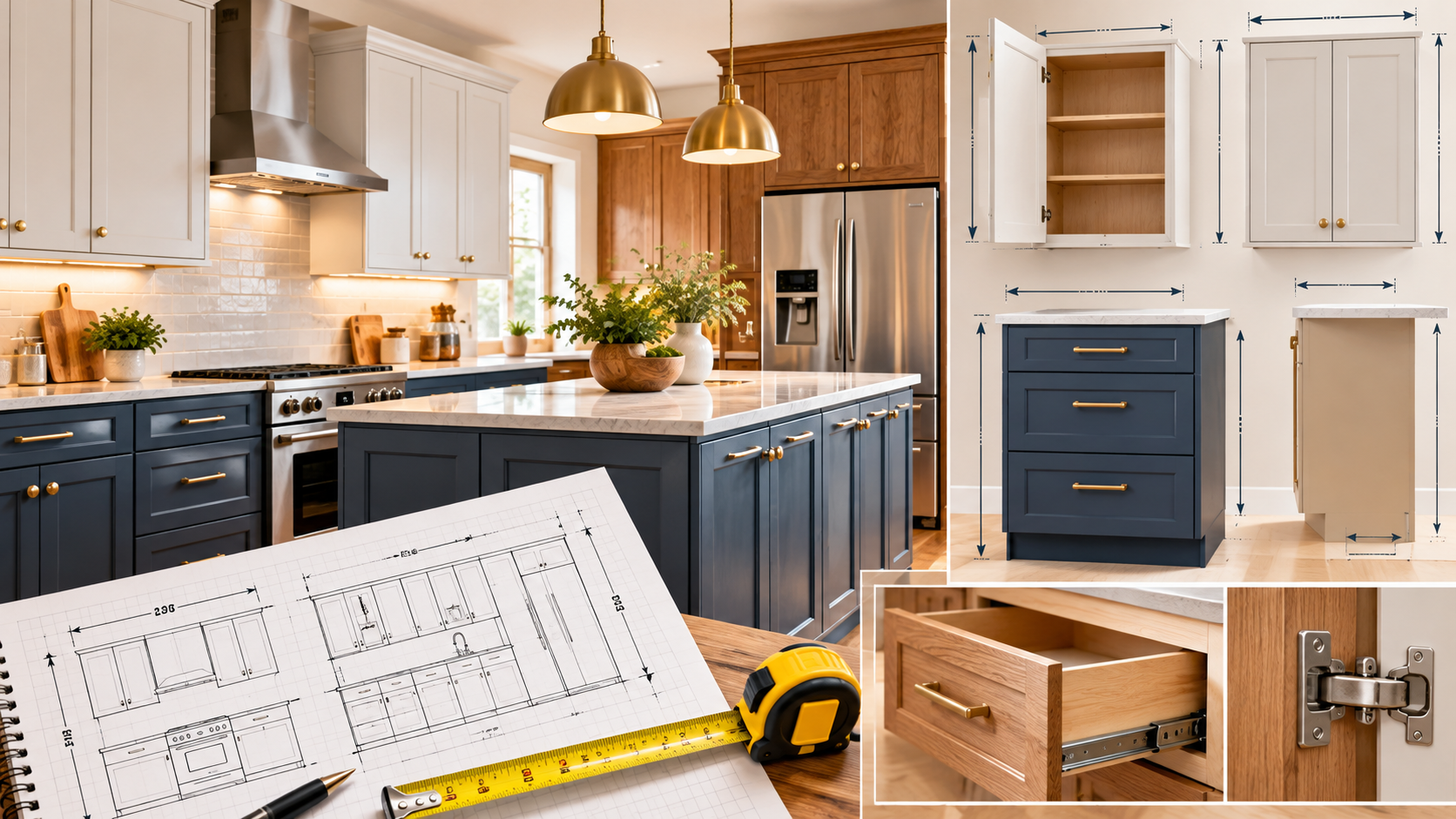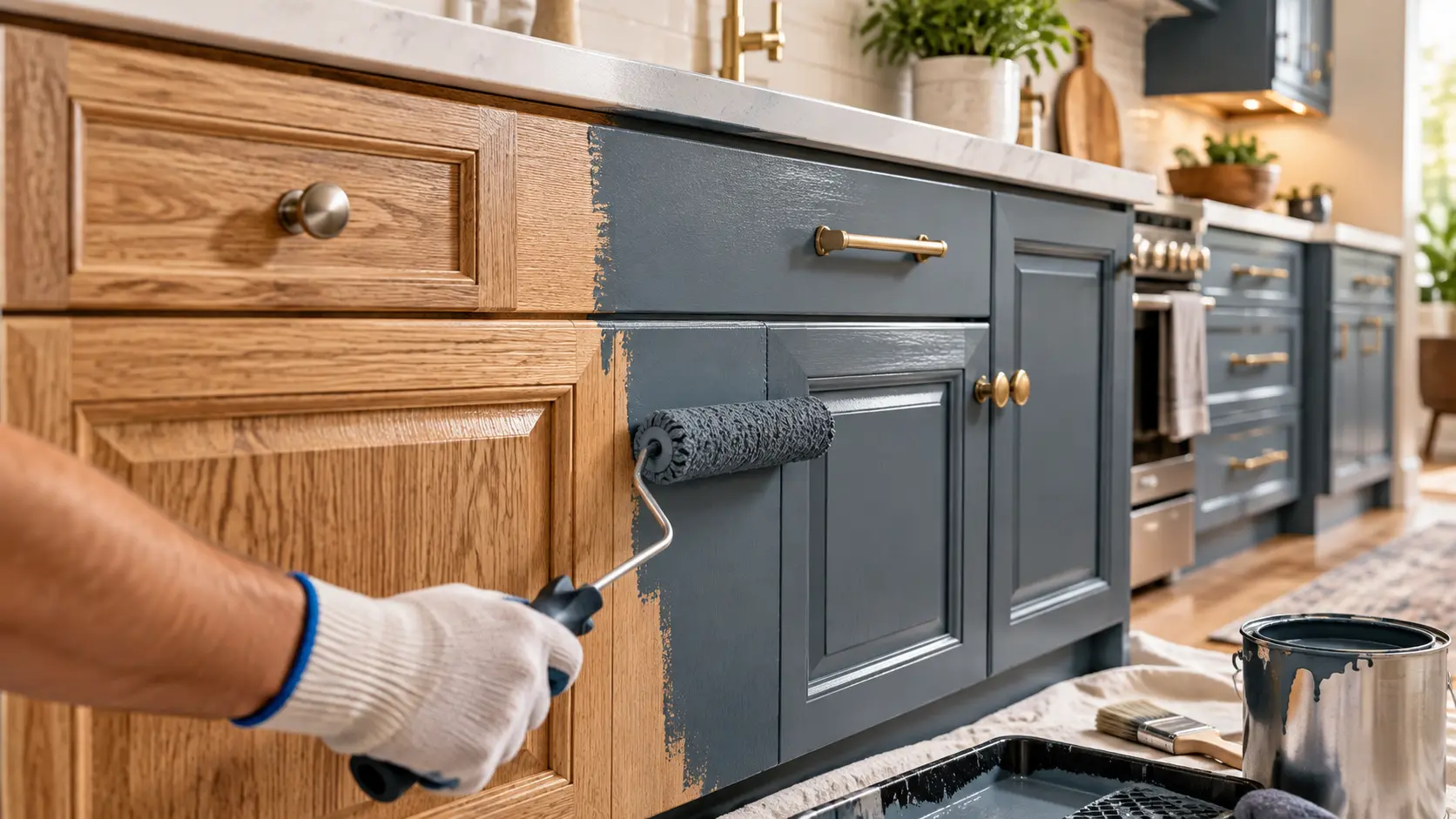

Kitchen cabinet organizers are the part of a quote people either skip entirely or over-order, and both are expensive mistakes in different directions. Skipping them means paying for cabinet volume you cannot reach, and over-ordering means paying for mechanisms that sit unused behind a door for a decade.
This guide separates the inserts that change how a kitchen works every day from the ones that look good on a showroom display and go quiet at home. It also covers the trade-off nobody mentions at the point of sale, which is that almost every organizer costs you some of the volume it is organizing.
 The trade-off behind every insert
An organizer is a mechanism, and a mechanism occupies space.
A pull-out tray assembly sits inside the cabinet box and needs running clearance on both sides. A rotating corner unit needs a circle of space inside a square box, and the corners of that square are lost. A drawer insert has walls, and the walls take width.
So the question for every insert is not whether it is useful in the abstract. It is whether the access it gives you is worth the volume it takes from you. For things you reach for daily, it nearly always is. For things you reach for twice a year, it nearly never is.
That single test explains most of what follows.
The inserts that earn their place
These are the ones that get used, in rough order of how much difference they make.
Drawers instead of doors in the base run
This is not strictly an organizer, and it is the single largest improvement available in a kitchen.
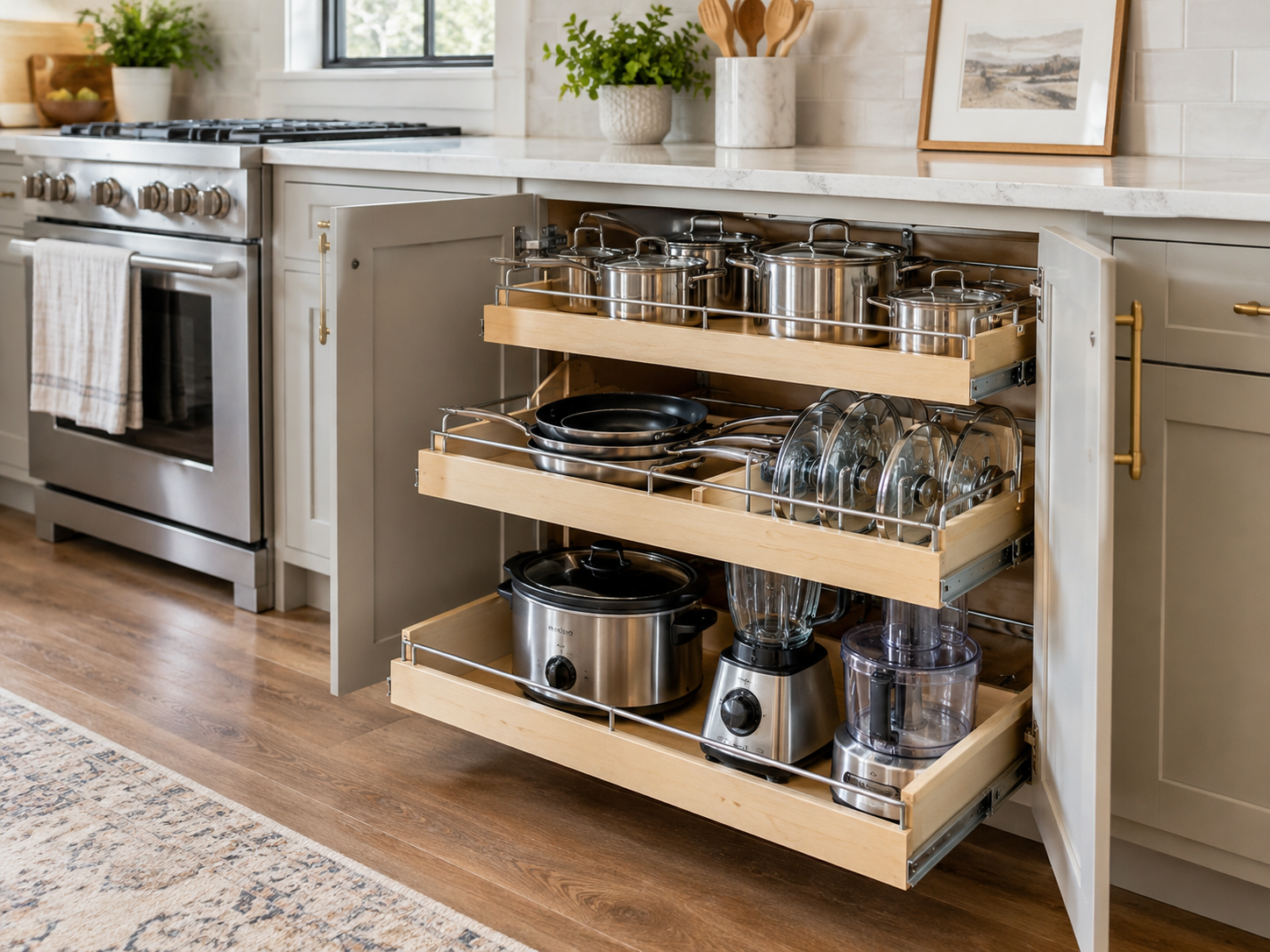
A base cabinet with a door and a fixed shelf requires kneeling and reaching into a dark box. The back third is effectively storage you visit once a season. The same cabinet built as three drawers presents everything at once when it is open, and the back of the drawer is as accessible as the front.
The cost difference is real, since a drawer is more hardware and more parts than a shelf. It is also the money in a kitchen that changes the most about daily use.
Where it matters most: pots and pans, food storage containers, and anything stacked. A deep drawer with a divider holds pans better than any door cabinet of the same size.
 Corner solutions
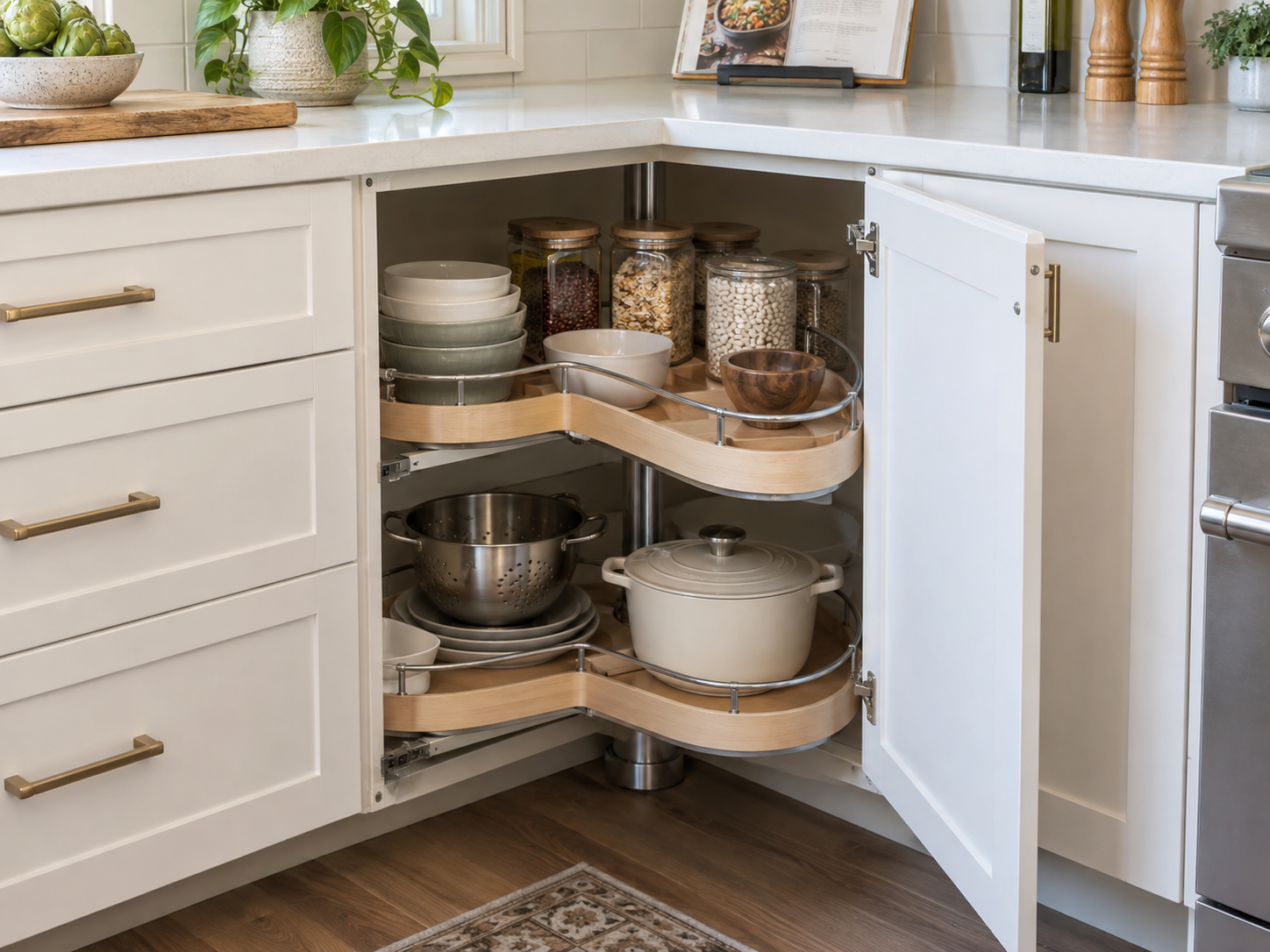
An inside corner in a base run creates a cabinet whose volume extends around a turn you cannot see into. Left alone, a substantial part of that volume is dead.
There are two mechanisms in common use.
Rotating corner units, sometimes called lazy susans. Shelves that turn, so the back comes to the front. They lose the square corners of the box to the circle, which is a real volume cost, but what remains is fully reachable.
Blind corner pull-outs. A tray system that slides out and swings clear of the opening, bringing the hidden section forward. They tend to recover more volume than a rotating unit and they cost more, and the mechanism carries a weight limit worth checking against what you plan to put there.
The third option is to do nothing and accept a dead corner with a filler panel. For a household with plenty of storage elsewhere that is a defensible choice and it saves money. For a household short of space it is the most expensive decision in the kitchen, because you are paying for cabinet you cannot use.
Pull-out waste and recycling units
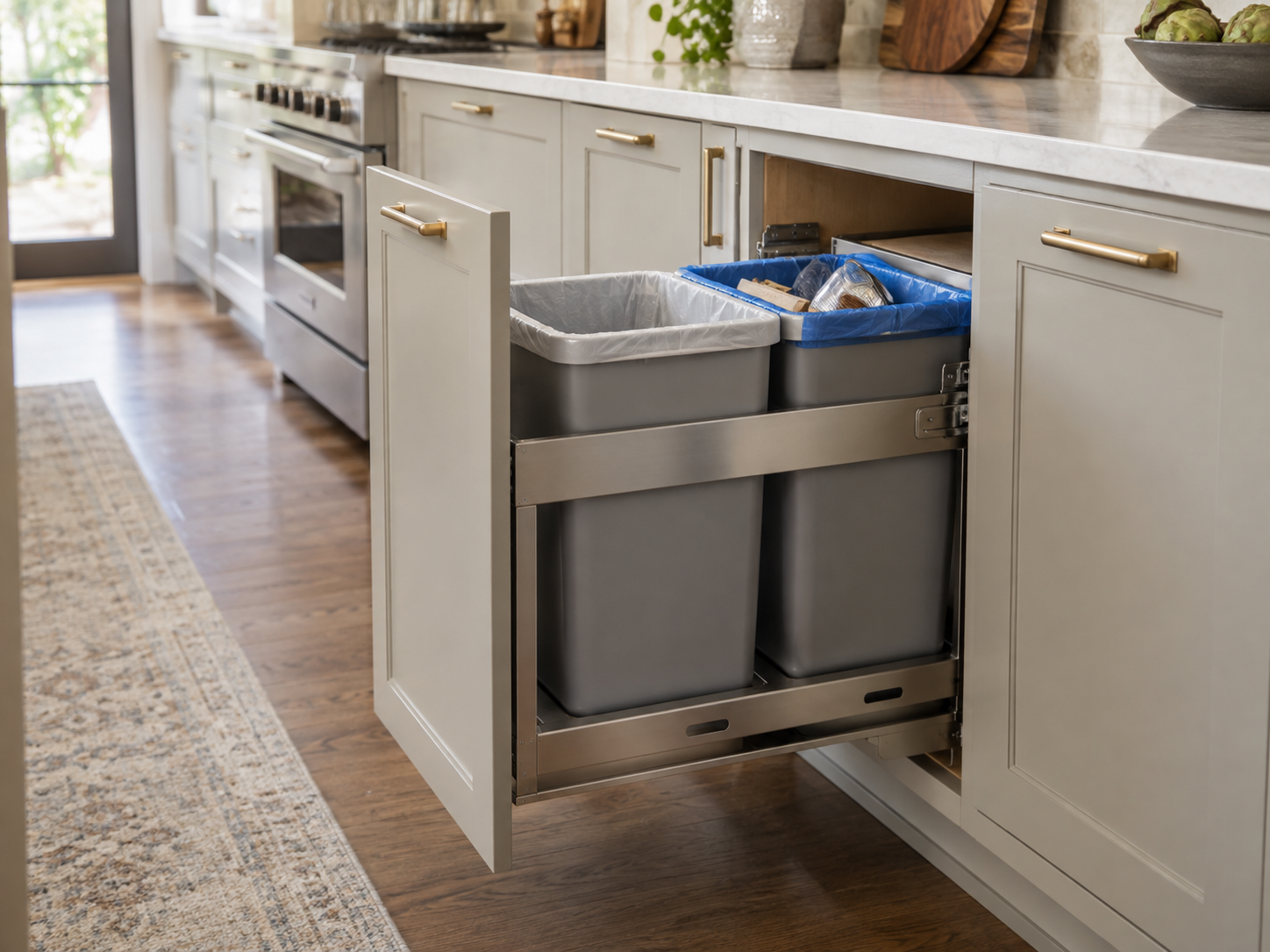
Two bins on a slide behind a cabinet door, usually next to the sink.
This is the insert people are most surprised by, because it sounds like a minor convenience and it changes the room. A freestanding bin takes floor space, it is the thing everybody walks into, and it is visible. Putting it inside a cabinet removes all three problems at once.
The practical points: a double unit lets you separate recycling without a second bin somewhere else, and the cabinet it goes in should be close to the sink and the prep counter rather than tucked at the end of a run.
Tray and sheet pan dividers
Vertical partitions in a tall, narrow cabinet, so baking sheets, cutting boards, muffin tins and cooling racks stand on edge rather than lying in a stack.
Flat items stored horizontally are the worst storage problem in any kitchen, because getting the one at the bottom means lifting everything above it. Standing them on edge means every item is reachable independently.
This is a cheap insert that solves a daily annoyance, which is a good combination. The cabinet above a wall oven or beside a refrigerator is often the natural home for it.
Drawer dividers for cutlery and utensils
Obvious for cutlery, and most kitchens have this already. Less obvious and more useful is a second divided drawer for cooking utensils, which otherwise become a jumble that you dig through.
The upgrade worth considering is a two-tier insert, where a shallow tray sits above and slides aside to reach the deeper section below. In a deep drawer that doubles the usable surface.
Under-sink organization
The cabinet under the sink is the worst-shaped storage in the kitchen, because the trap, the waste disposal and the supply lines all intrude into it, and every one of them is in a different place in every kitchen.
A purpose-made under-sink pull-out that is built around the plumbing beats a shelf every time. The alternative is a tiered shelf unit that sits around the trap, which is cheaper and less effective.
Worth saying plainly: this cabinet is also where leaks show up first. Whatever goes in there should be something you can remove quickly.
 The inserts that get ordered and forgotten
These are not bad products. They are products that a specific household needs and most households do not, and they are frequently sold as standard additions.
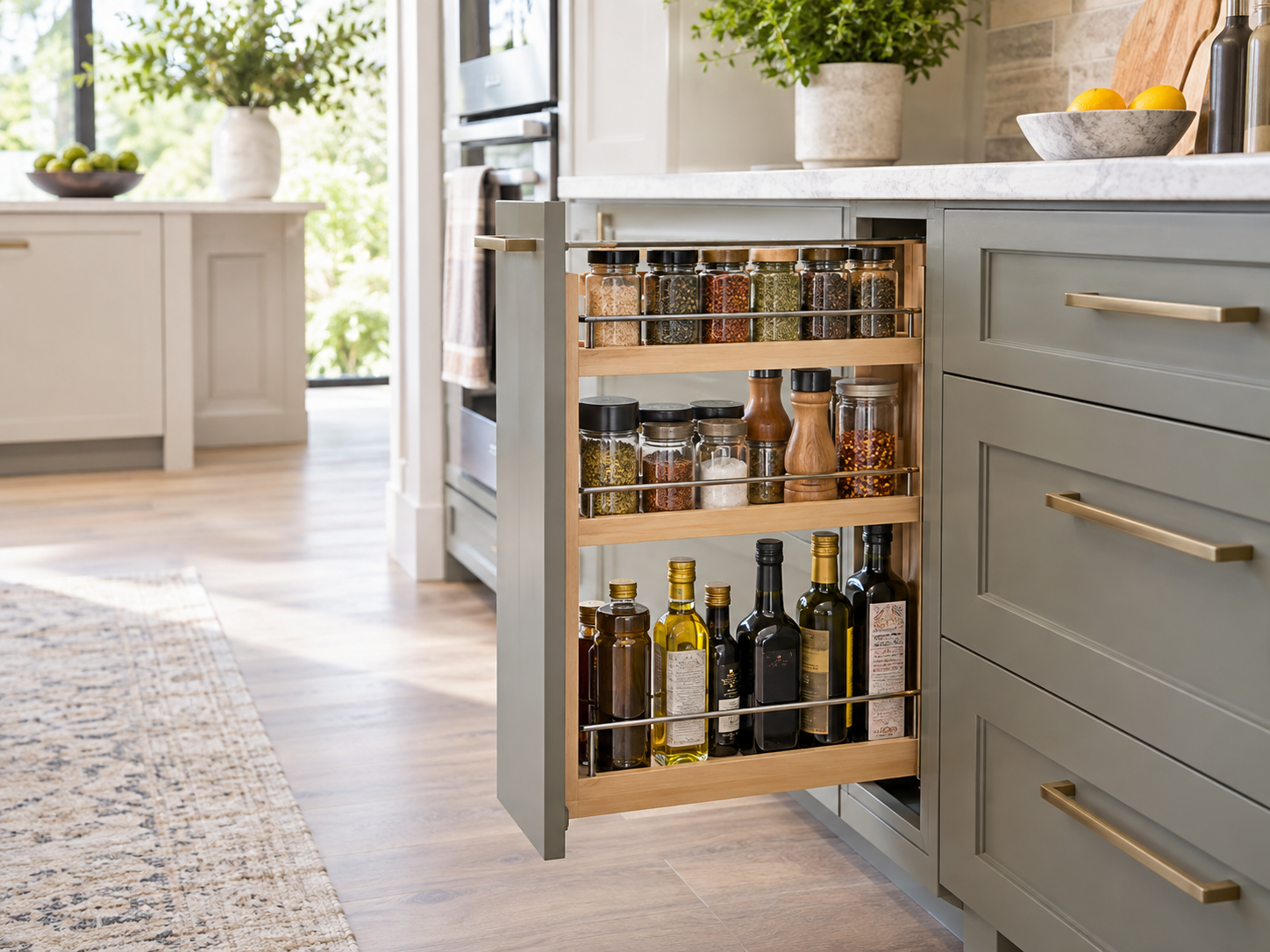
Spice pull-outs. A narrow vertical rack beside the range. Genuinely useful if you cook with a wide range of spices and replace them regularly. If your spices live in a drawer and you use six of them, this is a mechanism doing the work of a shelf.
Wine racks built into the cabinetry. Fixed diagonal storage for bottles, built in at the time of the kitchen. The problem is that it is permanent: the volume is committed to bottles whether or not you have bottles. A household that does not keep wine in the kitchen ends up with a decorative feature.
Appliance garages. A cabinet with a roll-up or lift-up door on the countertop, intended to hide the toaster and the coffee machine. They work when the appliances inside are used daily and stay plugged in. They fail when the door becomes one more thing to open, at which point the appliances migrate back out onto the counter and the garage holds nothing.
Pull-out towel and tray racks in narrow fillers. Often sold to make use of a 3 or 6 inch gap. Sometimes exactly right. Frequently a mechanism holding two baking sheets that could have lived in a divider for a fraction of the cost.
Multiple specialty inserts chosen before you live in the kitchen. This is the pattern rather than a single product. Inserts are easier to add later than to remove, and a kitchen tells you what it needs within about three months. Ordering the essentials at build and adding the rest afterwards is usually the better sequence.
Wall cabinets and tall units
Most organizer conversations are about base cabinets, and the upper half of the kitchen has its own problems.
The top shelf of a wall cabinet is not real storage for most people. A 42 inch wall cabinet on a standard 54 inch mounting height puts the top shelf around 8 feet from the floor. For reference, the US Access Board puts comfortable high forward reach at 48 inches in an accessible design. You do not have to design a private kitchen to that standard, but it makes the point: the top shelf is for things you get out with a step stool twice a year, and it should be planned that way rather than treated as everyday capacity.
Pull-down shelf mechanisms bring the top shelf of a wall cabinet down and forward. They are expensive per cabinet and they are the right answer in a specific case, which is a household where reach is a genuine constraint and the kitchen is not being redesigned around it.
Tall pantry units with pull-out shelves are a different proposition and generally worth it. A pantry with fixed shelves at 22 inches deep has the same problem as a deep base cabinet: the back row disappears. Pull-out shelves solve it, and in a unit you open every day the mechanism earns its cost quickly.
Roll-out trays in any deep cabinet follow the same logic. Depth without access is not storage.
What to specify, in what order
If you are building a kitchen and deciding where the accessory budget goes, this is a defensible order.
- Drawers rather than doors in the base run, wherever the budget reaches. Biggest single change.
- A corner solution for every inside corner. Deciding not to have one is fine, as long as it is a decision.
- A pull-out waste unit near the sink.
- Tray dividers in one tall narrow cabinet.
- A divided drawer for utensils in addition to the cutlery drawer.
- Pull-out shelves in the pantry, if there is a pantry.
- Everything else, later, once you have cooked in the room.
That list covers most of the practical gain at a fraction of the cost of a fully loaded accessory package.
Hardware is part of this too
The other thing you touch constantly is the hardware, and it is worth specifying deliberately rather than leaving to the end.
Two points that come up repeatedly. Drawers wider than about 24 inches want a pull rather than a single centre knob, because a knob in the middle of a wide drawer racks it slightly on every opening. And pull length should relate to the drawer it sits on: roughly a third of the drawer width reads correctly, with some latitude either side.
Our range of knobs and pulls covers the finishes, and mixing metals is accepted now as long as there is a logic to it. One metal for plumbing and another for cabinet hardware works. Four finishes accumulated over eight years does not.
A note on quality standards
Cabinet accessories are mechanisms, and mechanisms are where cheap cabinetry usually shows itself first. A drawer slide that is rated for light duty will feel fine on day one and sag under a drawer of pans within a couple of years.
The industry performance standard for cabinet construction and hardware is ANSI/KCMA A161.1, which sets out structural, drawer and door cycle tests. It is worth knowing the standard exists and worth asking which of the products in front of you are tested to it, since certification is granted to specific product lines rather than to a manufacturer’s entire catalogue.
The practical version of the same point: ask about the slides and the hinges specifically. Soft-close is now common rather than premium, and full-extension slides are the difference between reaching the back of a drawer and not.
 Frequently asked questions
Are cabinet organizers worth the extra cost?
Some are and some are not, and the test is frequency of use. An insert that gives daily access to something you use daily pays for itself in convenience. An insert that organizes something you touch twice a year is paying for a mechanism to hold still. Drawers instead of doors, a corner solution and a pull-out waste unit are the three that almost every household gets value from.
Can organizers be added to cabinets I already have?
Many can. Roll-out trays, drawer dividers, tray dividers and under-sink units are frequently retrofitted, provided the cabinet opening and the interior dimensions suit. What generally cannot be retrofitted is converting a door cabinet to drawers, since that changes the cabinet front. Measure the clear opening rather than the cabinet width, because the opening is what the insert has to pass through.
Do pull-outs and lazy susans reduce storage space?
Yes, and the question is whether the access is worth it. A rotating corner unit loses the square corners of the box to the circle. A pull-out tray loses running clearance on both sides. In a corner cabinet the trade is clearly worth it, because the alternative is volume you cannot reach at all. In an already accessible cabinet it is a closer call.
What is the difference between a blind corner pull-out and a lazy susan?
A lazy susan rotates, so the back of the shelf comes to the front. A blind corner pull-out slides and swings the hidden section out through the opening. The pull-out usually recovers more of the cabinet volume and costs more, and its mechanism has a stated weight limit. The rotating unit is simpler and generally cheaper.
Should I order accessories with the cabinets or add them later?
Order the structural decisions with the cabinets, since drawers versus doors and corner solutions cannot be changed afterwards without new cabinetry. Inserts that drop into an existing box, such as dividers, trays and under-sink units, can reasonably wait until you have used the kitchen and know what it needs.
How much weight can a pull-out shelf hold?
It depends entirely on the mechanism, and the manufacturer states a figure for each one. The reason to check rather than assume is that the failure mode is gradual: an overloaded slide does not break, it starts to bind and sag, and by then the cabinet is full. If a pull-out is destined for cast iron or small appliances, specify for that at the outset.
Getting the specification right
The useful way to think about kitchen cabinet organizers is not as a list of products to choose from but as a set of answers to a smaller question: which parts of this kitchen will I be unable to reach, and what is the cheapest way to fix each one.
Corners, deep base cabinets, the space under the sink and the top of any pantry are the four places where volume goes unreachable. Solve those, put drawers where the heavy daily items live, and leave the rest until the kitchen has told you what it is missing.
Our accessories range covers the inserts and hardware discussed here, and you can see how they work in a real cabinet at any of our showrooms. If you are planning the kitchen rather than finishing one, our kitchen layout guide and cabinet cost guide cover the decisions that come first. Contractors and builders specifying across multiple units can work with our professional design services team.